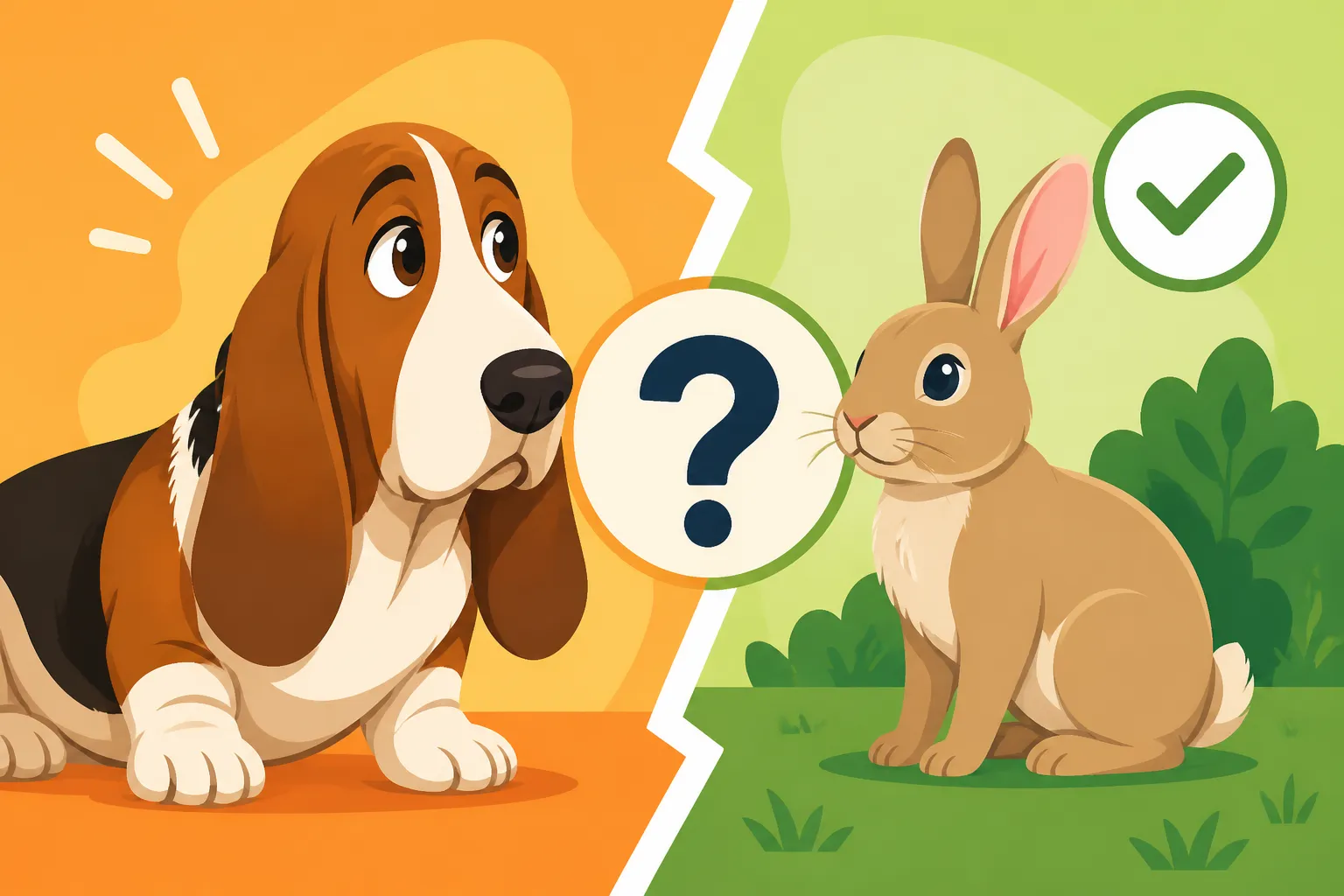
Whether a Basset Hound Is Safe With Rabbits
Bringing a new pet into your home is always exciting, but when you already have a Basset Hound and are considering adding a small, furry creature like a rabbit, a very real and serious question often pops up: can they actually live together safely? It’s a common frustration for Basset owners because we love our hounds dearly, but we also know that beneath that wonderfully floppy, laid-back exterior lies a deep-rooted hunting instinct. This guide is here to walk you through the complexities of Basset Hounds and rabbits coexisting, offering realistic expectations and practical advice to help you make an informed decision for the safety and well-being of all your beloved animals.
Understanding the Basset Hound's Natural Instincts
Before we even begin to talk about introductions or management, it's absolutely crucial to understand the very essence of what a Basset Hound is: a scent hound. Their entire being is designed for tracking prey, and that instinct isn't something you can easily train away, no matter how sweet-natured or well-behaved your individual dog might be.
The Ancestral Role: Scent Hounds and Their Prey Drive
Basset Hounds were originally bred in France for hunting small game, primarily rabbits and hare. Their incredibly powerful noses, those long, low-slung bodies, and those massive, scent-gathering ears were all specifically developed to follow a scent trail relentlessly. They weren't meant to be fast, but they were meant to be thorough and persistent. When a Basset Hound catches a whiff of a rabbit, or even just sees one dart across its field of vision, it triggers a deeply ingrained ancestral response. This isn't malice; it's simply a hound doing what hundreds of years of selective breeding have equipped it to do. It’s hardwired into them.
Think about it: they are literally built for this. Their low stature keeps their nose close to the ground, those long ears actually sweep scent upwards towards their nostrils, and their loose skin around the neck, known as a dewlap, helps trap scent particles. Every physical attribute points to their purpose. To ignore this fundamental aspect of their breed is to set both your Basset and any potential rabbit up for potential tragedy. The Nose That Puts a Basset Hound Second to a Bloodhound can give you an idea of just how profound their sense of smell is, and how compelling a rabbit's scent would be.
Why "Good Behavior" Doesn't Always Override Instinct
You might have the most obedient Basset Hound on the planet. They might sit, stay, come when called (most of the time!), and be the perfect couch potato. However, when that prey drive kicks in, it's a completely different game. It's like asking a fish not to swim. When a Basset Hound locks onto a scent or a movement, their world narrows. They literally stop hearing you, stop seeing anything else, and become singularly focused on the hunt. This isn't them being "stubborn"; it's their primal instinct taking over, often overriding all learned commands. Why a Basset Hound Stops Hearing You When It Smells Something delves deeper into this phenomenon.
Many owners mistakenly believe that because their Basset is gentle with the family cat or doesn't actively chase squirrels in the yard, a rabbit will be fine. But a rabbit's natural panic response – darting, freezing, and bolting – can mimic the exact behaviors that trigger a Basset's hunting sequence. Even if your Basset is merely "playing," that play can quickly become fatal for a fragile rabbit. Their sheer size and jaw strength, combined with the instinct to shake prey, means even an accidental bite or rough "play" can cause severe internal injuries or outright kill a rabbit in seconds.
The Realities of Coexistence: Risks and Challenges
Let's be brutally honest: introducing a Basset Hound to a rabbit comes with significant risks that cannot be entirely eliminated. It’s not just about what could happen, but what is statistically and instinctively likely to happen given the Basset's genetic programming.
The Size and Speed Mismatch
While Basset Hounds aren't sprinters, they are surprisingly powerful and determined. A typical adult Basset can weigh anywhere from 40 to 60 pounds, sometimes more. Compare that to a rabbit, which might weigh a mere 2 to 10 pounds. The sheer difference in size means that even an unintentional bump or playful paw can seriously injure a rabbit, whose bones are delicate and whose internal organs are vulnerable.
Imagine a large, muscular dog, built with a strong jaw and a powerful neck, engaging with a tiny, fragile creature. The outcome is rarely in the rabbit's favor. Rabbits are also incredibly fast over short distances, and their instinct is to flee. This flight response is precisely what can ignite the chase instinct in a Basset, turning what you might hope would be a peaceful interaction into a perilous pursuit. Even if your Basset has never caught anything before, the opportunity presented by a live rabbit in their personal space is a powerful stimulus. Whether a Basset Hound Still Hunts illustrates their enduring capabilities.
The "Play" That Can Turn Deadly
One of the most heart-wrenching scenarios owners face is when a Basset Hound's "play" with a rabbit escalates into something far more serious. A Basset might not start with the intention to kill. It might simply want to sniff, nudge, or chase. But a rabbit's fear-induced flight can trigger the Basset's predatory sequence, moving from chase to capture. Bassets, like many hounds, are capable of what's called a "kill shake" – a swift, violent shake of their head designed to dispatch prey. This action, even if born of instinct rather than malice, would be catastrophic for a rabbit.
It's important to remember that dogs don't understand the fragility of small prey animals in the same way we do. They don't differentiate between a plush toy and a living rabbit when their instincts are fully engaged. The sudden, unpredictable movements of a rabbit can push a Basset over the edge from curiosity to full-blown prey drive in an instant. Furthermore, the rabbit lives in a constant state of fear and stress, which significantly impacts their health and lifespan, even if physical harm never occurs.
Practical Strategies for Managing the Risk
If you are committed to having both a Basset Hound and a rabbit under the same roof, stringent management and realistic expectations are paramount. This isn't about training your Basset not to be a Basset; it's about managing their environment to prevent their natural instincts from ever coming into play with your rabbit.
Strict Supervision and Physical Barriers
The golden rule for housing Basset Hounds and rabbits together is never, ever leave them unsupervised, even for a second. This means not in the same room, not with just a gate between them, and certainly not with just a flimsy cage. Separation must be absolute. Think about robust, unyielding physical barriers.
You'll need high-quality, sturdy crates for your Basset, especially if you need to leave the house. Look for options on platforms like Amazon for heavy-duty metal crates that your Basset cannot break out of. These aren't just for training or temporary containment; they are a critical safety measure. Similarly, baby gates – the tall, pressure-mounted or hardware-mounted kind – can help create zones within your home where the rabbit is completely inaccessible to your Basset. Consider double gating if your Basset is particularly persistent or a jumper (though Bassets aren't known for their jumping prowess, determination makes up for a lot!). What a Crate That Fits a Basset Hound Costs might be useful in planning your budget for such necessities.
For the rabbit, their enclosure must be absolutely dog-proof. This means a solid hutch that cannot be chewed through or broken into, with a secure lock that your Basset can't manipulate. Outdoor hutches need extra reinforcement to protect against any determined digging or pushing from a Basset. Remember, a Basset's nose is one of the most powerful tools in the animal kingdom, and if they smell a rabbit, they will exert an incredible amount of effort to reach it.
Training and Management: Realistic Expectations
While you can't erase a Basset's prey drive, you can work on management techniques and strong obedience cues that might, under ideal circumstances, give you a moment's pause to intervene. "Leave it" and "stay" are incredibly important commands to teach to a bulletproof standard. Practice these commands with increasingly high-value distractions, but understand that a live rabbit is the ultimate distraction.
Consider enrolling in positive reinforcement training classes, or exploring online resources like BAXTER & Bella, which offer structured programs that emphasize management and reliable cues. The focus should be on teaching your Basset to ignore distractions and to always look to you for direction. However, never rely solely on training to keep a rabbit safe. It's a layer of protection, not the primary defense.
When out on walks, always keep your Basset on a leash or a long line. Whether a Long Line Is Enough for a Basset Hound is a good read, as even seemingly secure areas can have wild rabbits, and one scent can send your Basset off into the wilderness, oblivious to your calls. A double-leash system (one attached to a collar, one to a harness) can provide extra security.
Considering the Rabbit's Welfare First
Beyond the immediate physical danger, consider the profound psychological stress a rabbit experiences when living in close proximity to a predator. Rabbits are prey animals by nature; they are constantly on alert. Even if your Basset never lays a paw on the rabbit, the constant presence, scent, or even the sound of a large dog can cause chronic stress, leading to a suppressed immune system, behavioral issues, and a significantly shortened lifespan for the rabbit.
A stressed rabbit might stop eating, become aggressive, or develop gastrointestinal problems. Their well-being must be prioritized. If you find your rabbit constantly hiding, thumping their foot (a sign of alarm), or exhibiting other stress behaviors, it's a clear sign that the living arrangement is not working for them, regardless of whether your Basset seems "fine" with it. This is not a situation where "they'll get used to it" is an acceptable approach.
Making the Best Decision for Both Animals
Ultimately, the decision of whether to house a Basset Hound and a rabbit together rests with you, but it should be a choice made with eyes wide open to the inherent risks and the significant responsibility involved.
Weighing the Pros and Cons
To help you visualize the challenges, here's a table summarizing the realities of this particular interspecies living arrangement:
| Feature | Basset Hound Perspective | Rabbit Perspective | Coexistence Outcome |
|---|---|---|---|
| Instinctive Behavior | Strong prey drive, excels at scent tracking. | Prey animal, highly sensitive to predators. | High risk of chase, injury, or death for the rabbit. |
| Physical Attributes | Powerful jaws, sturdy body, capable of "kill shake." | Fragile bones, delicate internal organs, small size. | Even "play" can be fatal for the rabbit. |
| Communication | Baying, sniffing, persistent pursuit. | Freezing, thumping, bolting, hiding. | Misinterpretation can escalate conflict. |
| Training Effectiveness | Can learn commands, but instinct can override. | Cannot be trained out of natural fear response. | Training is a management tool, not a guarantee of safety. |
| Stress Levels | May experience frustration from inability to chase. | Constant fear and stress, impacting health. | Detrimental to the rabbit's long-term well-being. |
| Management Effort | Requires constant, vigilant supervision and barriers. | Requires secure, impenetrable housing. | Extremely high, continuous effort from the owner. |
Prioritizing Safety Over Desire
It's natural to want all your beloved pets to get along like characters in a Disney movie, but reality often dictates a different scenario, especially when dealing with a breed like the Basset Hound and a natural prey animal. For the vast majority of Basset Hounds, and for the optimal welfare of a rabbit, the safest and most responsible approach is to keep them entirely separate, ensuring they never have direct access to each other. This might mean having them live in different parts of the house, or even deciding that your home is only suitable for one type of animal at a time.
If you already have both animals and are struggling, don't be ashamed to seek professional help. A qualified behaviorist might offer additional strategies for separation and management, but they will likely reinforce the message of absolute prevention rather than "training them to be friends." The peace of mind that comes from knowing both your Basset Hound and your rabbit are safe, secure, and stress-free is invaluable. It’s a hard truth, but sometimes the most loving thing you can do for your animals is to acknowledge their fundamental natures and arrange their lives accordingly.
Disclaimer
This article is for general informational purposes only and does not constitute professional advice. Laws, prices and regulations vary by location and change over time. Consult a qualified professional for guidance on your specific situation.