Whether a Basset Hound Walks on a Loose Leash
Ah, the daily leash walk with a Basset Hound. If you've ever felt like you're being dragged along by a small, low-slung, furry tractor, you're definitely not alone. Many Basset Hound owners find themselves wondering if a loose leash walk is just a mythical beast, a dream that's simply not achievable with their beloved scent hound. The truth is, while it presents unique challenges, a Basset Hound can absolutely learn to walk politely on a leash, and this guide is going to break down how to get there, tackling the frustrations head-on.
The Basset Hound's Natural Instincts vs. Leash Manners
Let's be real, your Basset isn't pulling on the leash out of spite. They're just being a Basset! Their entire being is engineered for one magnificent purpose: finding and following a scent trail. Understanding these powerful instincts is the first step to managing them.
Nose to the Ground: The Scent-Driven World of a Basset Hound
Imagine living in a world of incredible smells, where every gust of wind, every blade of grass, and every discarded wrapper tells a fascinating story. That's your Basset Hound's reality. Their long, pendulous ears actually help funnel scent towards their powerful noses, and their low stature keeps them close to the ground, where those scent particles linger longest. When a Basset's nose hits a "hot" trail – be it a squirrel that scurried by ten minutes ago or the faint whiff of last night's pizza crust – their entire world narrows to that single, compelling thread of odor.
In that moment, your Basset is in a sensory trance. The gentle tug of the leash, your encouraging words, even the promise of a treat might fade into the background. Their primal instinct to follow the trail takes over, and suddenly, you're just the anchor on the end of the rope. This isn't disobedience; it's instinctual drive. It's why phrases like "going deaf on purpose" are often playfully (or not-so-playfully) attributed to Basset Hounds. They are following their calling! For more on their incredible olfactory abilities, you might want to read How Good a Basset Hound's Nose Actually Is.
Independent Thinkers, Not Eager Followers
Unlike some breeds that live to please their human companions, Basset Hounds often possess a delightful, albeit sometimes frustrating, independent streak. They're not necessarily looking to you for constant direction in the same way a Border Collie might. Their job, historically, was to follow a scent, at their own pace, and they became rather good at it without much human micromanagement on the trail itself. This means that when it comes to leash walking, they often have their own agenda.
They're not trying to be "stubborn" in a malicious way. What we perceive as stubbornness is often simply a deep, inherent focus on what they find most interesting at that moment – usually a scent! If that scent is pulling them in a different direction than you want to go, then you're going to have a conflict of interest. They're not naturally inclined to walk neatly by your side, admiring the scenery with you. They're on an archaeological dig, one sniff at a time. This independence means that successful loose leash training requires more patience and creative motivation than with many other breeds.
Common Challenges in Loose Leash Training with a Basset Hound
So, we know why they pull. Now let's talk about the specific hurdles that make training a loose leash walk feel like an uphill battle.
The Battle of Strength and Momentum
Don't let their relatively small stature fool you; Basset Hounds are surprisingly strong! With their low center of gravity, heavy bone structure, and powerful neck and shoulders, they can generate a significant amount of force when they decide to pull. It often feels like walking a small tank on a rope. Many an owner has been surprised by the sheer strength their Basset can muster when they lock onto a particularly intriguing smell.
What often happens is a cycle: the Basset pulls, the owner pulls back. This creates an opposition reflex, where the dog learns that pulling against pressure is how they get to where they want to go. Every time you brace yourself and allow them to strain at the end of the leash, you are inadvertently teaching them that pulling works. It's a deeply ingrained habit that can be tough to break because, for the Basset, it has often yielded results – they get to sniff that exciting patch of grass just a little bit faster.
Consistency is Key, But Hard to Maintain
This is perhaps the biggest challenge for us humans. We know intellectually that consistency is crucial for dog training, but life happens. There are days when you're late for work, or it's pouring rain, or you're just plain exhausted, and you just need to get your Basset out for a quick potty break. On those days, it's easy to let the leash slack a bit, to tolerate a little pulling, or even to rush past a tempting sniff spot.
The problem is, even occasional lapses in your training can undermine weeks of hard work. If your Basset learns that pulling sometimes gets them what they want, they'll keep trying it. It's like a slot machine – if you win once in a while, you keep pulling that lever. This is where many owners get frustrated and give up, feeling like their Basset is untrainable. It's not the Basset; it's the lack of unwavering consistency, which, let's be fair, is incredibly difficult for busy humans! How Long a Basset Hound Can Be Left Alone touches on other daily management challenges.
Equipment That Helps or Harms
The right equipment can make a world of difference, and the wrong equipment can make training nearly impossible or even exacerbate the problem. A standard flat collar, for instance, offers very little control over a determined Basset Hound. When they pull, the pressure is primarily on their windpipe, which can be uncomfortable or even damaging, but it rarely deters their drive to follow a scent. It also reinforces that pulling simply means pressure on the neck.
Here's a quick rundown of common equipment and its impact:
| Equipment Type | Description | Pros | Cons |
|---|---|---|---|
| Flat Collar | Standard collar around the neck. | Easy to put on, good for ID tags. | Little control for pullers, can cause coughing/gagging, doesn't discourage pulling. |
| Choke/Slip Collar | Metal chain that tightens around the neck. | Provides quick correction with a swift tug. | Can be dangerous if used improperly, causes pain/discomfort, doesn't teach how to walk politely. |
| Prong Collar | Metal links with blunt prongs that pinch the neck. | Effective for some strong pullers when used correctly. | Aversive, can be painful, requires expert fitting and technique, controversial due to potential harm. |
| Front-Clip Harness | Clips at the chest, redirects dog's forward momentum. | Excellent for reducing pulling, safer for the dog's neck, widely available (e.g., on Amazon). | Can sometimes restrict shoulder movement if not fitted well, some dogs dislike the feel. |
| Head Halter | Fits over the muzzle and behind the ears, similar to a horse halter. | Offers significant control, steers the head, which steers the body. | Some dogs strongly resist it initially, requires desensitization, can be mistaken for a muzzle. |
| Back-Clip Harness | Clips on the dog's back. | Comfortable for the dog, good for dogs that don't pull much. | Can increase pulling for strong pullers as it allows them to lean into the harness with their full body. |
For Basset Hounds, a front-clip harness like the Balance Harness or an Easy Walk harness (often found easily on Amazon) can be a game-changer. These harnesses redirect your dog's forward momentum sideways when they pull, making it physically harder for them to drag you along. Head halters also offer excellent control by gently guiding their head, and where the head goes, the body often follows. Always choose equipment that is humane and designed to teach, rather than just punish.
Effective Strategies for Teaching a Basset Hound Loose Leash Walking
Now for the good stuff! While challenging, training your Basset to walk on a loose leash is absolutely achievable with the right approach.
Foundation Training: Start Indoors, Build Outdoors
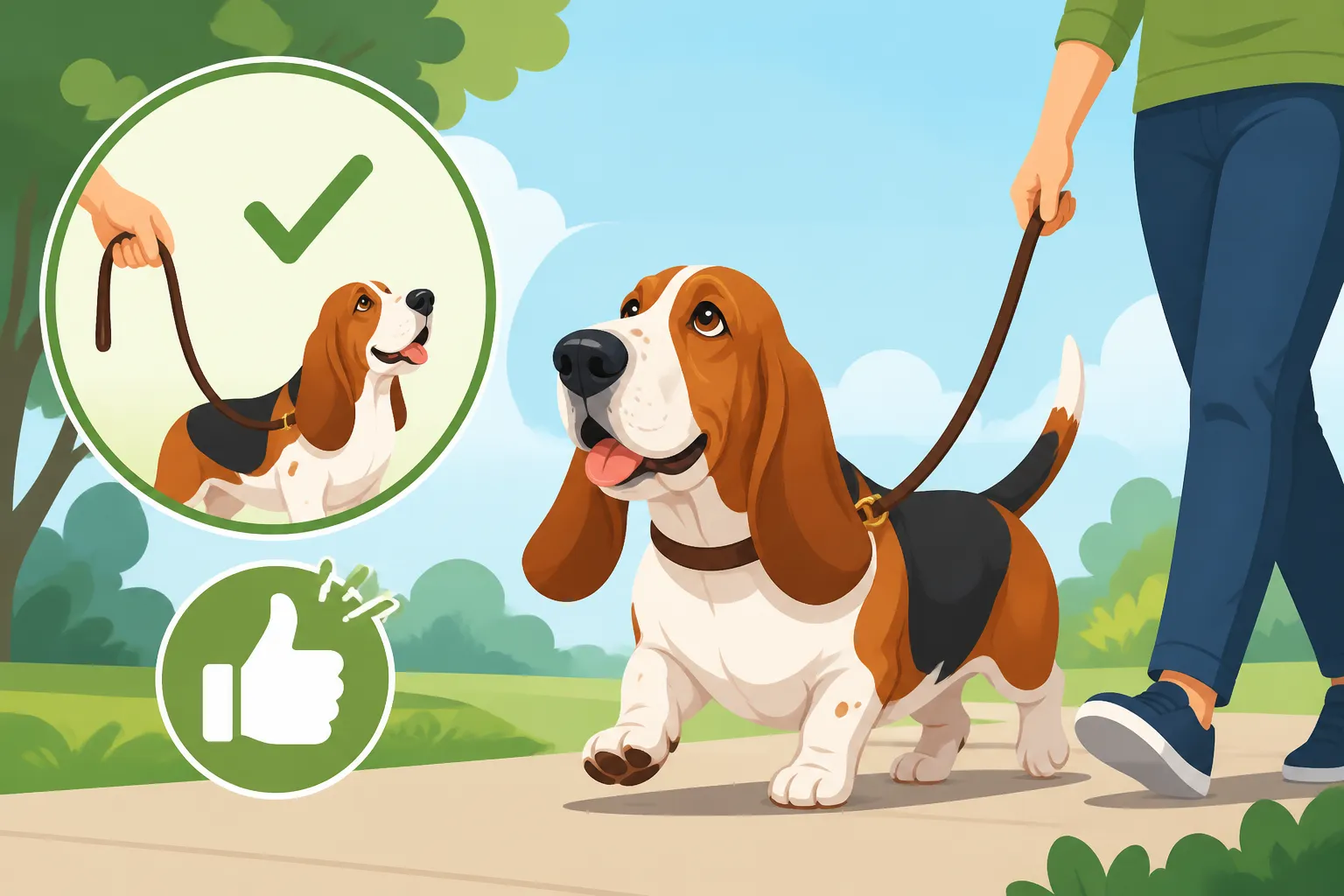
Before you even step outside, practice loose leash walking in a distraction-free environment. Your living room or a quiet hallway is perfect. Put the harness and leash on, and simply walk around. Every single time the leash is slack, mark that moment with a verbal cue ("yes!" or "good!") and a high-value treat. If the leash tightens, stop dead in your tracks.
The goal here is to teach your Basset that a slack leash equals good things (treats, praise, forward movement) and a tight leash equals absolutely nothing. This foundational work helps them understand the concept of a loose leash before the overwhelming scents of the outdoors take over. Keep sessions short, fun, and positive. Once they're reliably walking nicely indoors, gradually move to low-distraction outdoor areas like your backyard, then a quiet street, slowly increasing the challenge.
The "Stop and Go" Method
This is a classic for a reason, and it's incredibly effective, especially with a Basset Hound's unique motivations. The premise is simple:
- Start Walking: Begin your walk with a slack leash.
- Dog Pulls? Stop Dead!: The instant you feel tension on the leash, stop moving. Don't yank, don't scold, just become a statue.
- Wait for Slack: Wait patiently. Your Basset might turn to look at you, or glance at the leash, or simply relax their body. The moment, and I mean the instant, the leash goes slack (even for a second), mark it with your verbal cue and take one step forward.
- Reward and Resume: If they take that step with a loose leash, immediately reward them with a high-value treat right by your side. Then continue walking.
- Repeat, Repeat, Repeat: This process will feel painfully slow at first. You might take five steps, stop, wait, take two steps, stop. But your Basset will quickly start to connect: "Loose leash = forward movement and treats." "Tight leash = we stop."
Patience is your absolute superpower here. Do not let them drag you, even for a foot. Every inch they gain while pulling reinforces the wrong behavior. This method teaches them that they control the forward momentum by keeping the leash loose. How Many Miles a Basset Hound Can Walk might influence how long you plan these training walks.
Positive Reinforcement and High-Value Treats
Basset Hounds are, famously, highly food-motivated. This is a tremendous asset in training! Forget dry kibble; for loose leash walking, you need "high-value" treats. Think tiny pieces of cooked chicken, cheese, hot dogs, or whatever your Basset considers the absolute pinnacle of deliciousness. The smellier, the better.
Use these treats strategically:
- Frequent Rewards: In the beginning, reward every few steps they take on a loose leash. You want them to understand that this is the default, highly rewarding behavior.
- Proximity Rewards: Deliver the treat right next to your leg, encouraging them to stay close.
- Random Reinforcement: Once they start getting the hang of it, begin to randomize the rewards. Sometimes they get a treat after three steps, sometimes ten, sometimes five. This keeps them engaged and guessing, making the behavior stronger.
- Praise: Combine treats with enthusiastic verbal praise. They might not be as eager to please as a retriever, but they appreciate your happy voice!
Consistency in rewarding good behavior will build a strong positive association with walking nicely beside you. What Actually Motivates a Basset Hound delves deeper into what makes your Basset tick.
Incorporating Scent Work and Mental Stimulation
Remember that powerful nose? You can't turn it off, but you can channel it! Trying to completely suppress a Basset's natural desire to sniff is like trying to stop a fish from swimming. It's frustrating for everyone. Instead, build planned "sniff breaks" into your walks.
Here's how:
- Earned Sniffs: Ask your Basset to walk nicely for a certain distance (say, 50 feet). When they do, stop at a particularly interesting patch of grass or bush and give them a release cue like "Go sniff!" Let them have a good, solid 30-60 seconds of uninterrupted sniffing. This is their reward for good walking.
- Scent Games: Incorporate dedicated scent work at home or in a safe, fenced area before your walks. Hide treats around the house and let them find them. Use snuffle mats or puzzle toys. This mental exercise can help tire out their brain, making them slightly less frantic to sniff every single thing on a structured walk. Many resources for scent work games can be found through platforms like BAXTER & Bella, offering online classes and ideas to engage your dog's natural talents.
- Long Lines: In a safe, open area (away from traffic!), consider using a long line (15-30 feet) attached to a secure harness. This allows them to explore and follow scents more freely under your supervision, satisfying that drive without allowing them to practice pulling on a short leash. You can find excellent quality long lines readily available from retailers like Amazon.
By giving them appropriate outlets for their sniffing instincts, you can reduce the intensity of their pulling during structured loose leash walks.
When to Seek Professional Help and Manage Expectations
Even with the best intentions and consistent effort, training a Basset Hound can be tough. It's okay to ask for help, and it's important to have realistic expectations.
Recognizing When You Need an Expert
If you've been diligently working on loose leash walking for a significant period (say, a few months) and feel like you're making little to no progress, or if your frustration levels are through the roof, it might be time to call in a professional. A certified professional dog trainer (CPDT-KA) or a force-free trainer can offer:
- Objective Assessment: They can observe your interactions and your Basset's behavior, identifying subtle cues or habits you might be missing.
- Customized Strategies: What works for one Basset might not work for another. A trainer can tailor techniques to your specific dog's personality and your lifestyle.
- Hands-On Guidance: There's no substitute for a trainer actually working with you and your dog, demonstrating techniques and providing immediate feedback.
- New Tools and Resources: They might introduce you to different types of equipment or training exercises you hadn't considered.
Don't view seeking a trainer as a failure; view it as an investment in a more enjoyable relationship with your Basset. They can often provide the breakthrough you need to turn frustrating walks into pleasant strolls.
Managing Expectations: It's a Journey, Not a Race
Here's the realistic talk: your Basset Hound may never walk with the precision of a German Shepherd in an obedience ring. Their inherent design and instincts mean they will always be drawn to scents, and there will likely be moments when their nose takes precedence. The goal isn't necessarily perfection, but rather significant improvement and a more harmonious walking experience.
Celebrate the small victories:
- A few blocks of perfectly loose leash walking is a huge win!
- Your Basset checking in with you instead of pulling non-stop is fantastic.
- Being able to walk comfortably without your shoulder feeling dislocated is progress.
Remember that a Basset's life is relatively short, and the bond you share is paramount. While training for a loose leash is important for safety and enjoyment, don't let the pursuit of perfection overshadow the joy of simply being with your wonderfully quirky, scent-obsessed companion. The journey of training is also a journey of understanding and deepening your relationship. So, go forth, arm yourself with high-value treats and patience, and enjoy the adventure with your Basset Hound, one loose-leashed step at a time!
Disclaimer
This article is for general informational purposes only and does not constitute professional advice. Laws, prices and regulations vary by location and change over time. Consult a qualified professional for guidance on your specific situation.