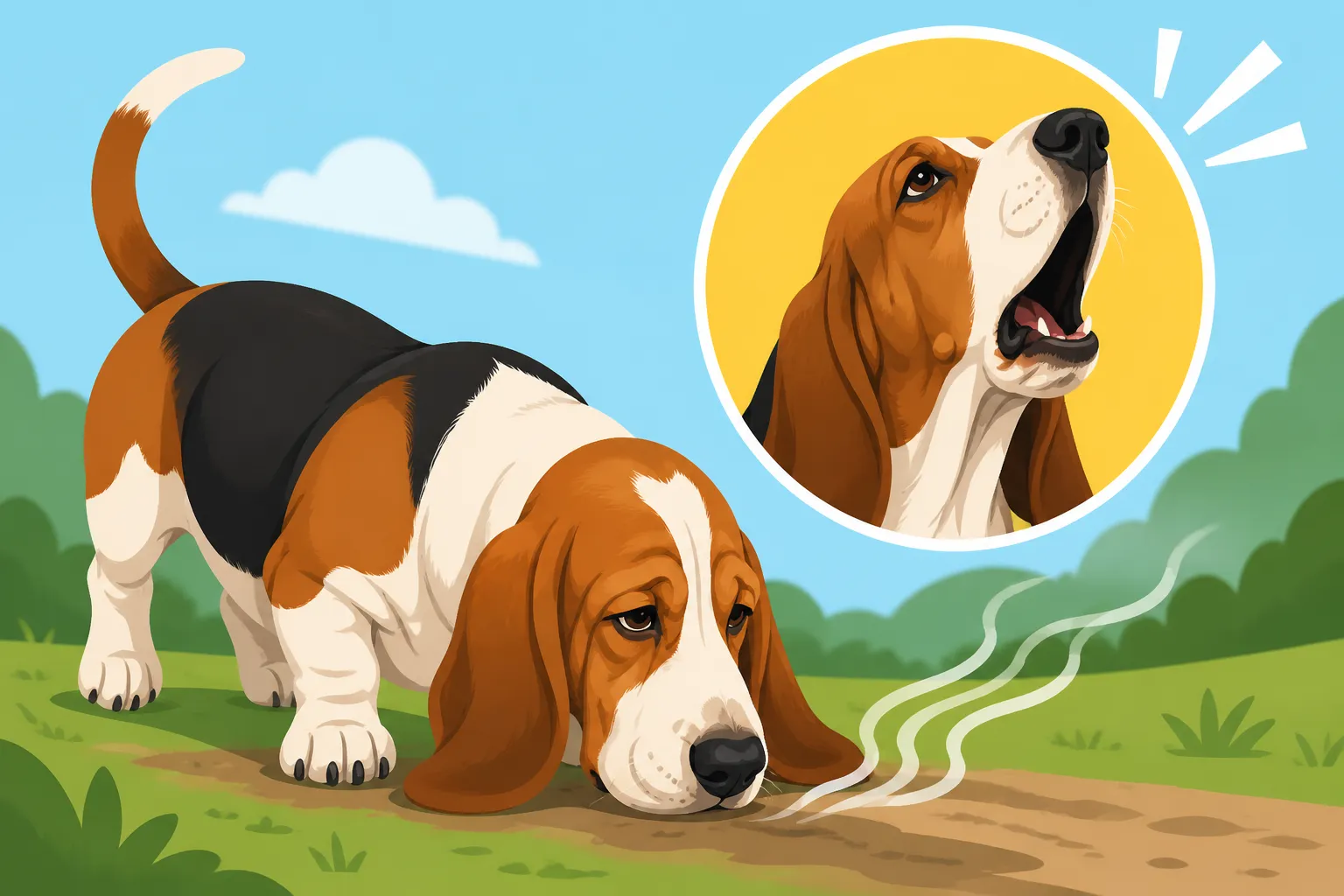
Whether a Basset Hound Bays When It Finds a Scent
There’s a moment every Basset Hound owner experiences – that sudden, profound silence on a walk, followed by an unmistakable, resonant bay that seems to shake the very ground. It’s usually when their incredible nose has locked onto something truly fascinating. This guide is all about understanding why your Basset Hound bays with such gusto when they find a scent, what that vocalization means, and how you can live harmoniously with this deeply ingrained instinct.
The Basset Hound's Nose: A World Apart
Let's be honest, you didn't get a Basset Hound for their lightning-fast recall or their Olympic-level agility. You got them for those soulful eyes, those ridiculously long ears, and that utterly charming, low-slung body. But underneath all that endearing personality lies one of the most powerful scenting machines in the canine world. When that nose engages, the world as your Basset knows it shrinks down to a single, captivating trail of odor, and everything else simply fades away.
The Instinct to Hunt and Trail
Basset Hounds were originally bred for a very specific purpose: to hunt small game, particularly rabbits and hare, by following a scent trail. Their entire physical design – from those long, low-set ears that sweep scent particles towards their nose, to their loose skin that helps trap scent, and their short legs that keep them slow enough for human hunters on foot to keep up – is geared towards scent work. It’s not just a hobby for them; it’s their very essence. When a Basset Hound's nose hits a strong, intriguing scent, it's like an ancient switch flips inside them. They are no longer just your cuddly companion; they are a hound, on the trail, doing what generations of their ancestors were bred to do.
Imagine you're out for a leisurely stroll in the park with your Basset, let's call him Winston. One moment he's trotting amiably beside you, the next his head drops, his tail begins a slow, deliberate wag, and his body becomes a rigid, low-slung arrow pointing towards an unseen target. His entire being is consumed by that invisible ribbon of scent. The moment his brain processes that a fresh, exciting trail has been found, that deep, booming bay erupts. It’s an involuntary, instinctual reaction, a proclamation to the world (or, more accurately, to his pack) that he's found something significant. This isn't stubbornness, nor is it a sign of disobedience; it's a powerful genetic imperative taking over.
Why the Bay is a Communication Tool
For centuries, the bay of a Basset Hound wasn't just noise; it was critical communication. When a pack of hounds was out hunting, the bay told the other dogs and the hunters, "Hey! I've got something! Follow me!" It kept the pack cohesive and alerted the human hunters to the progress of the chase. It's a fundamental part of their hunting strategy. Without it, the pack would scatter, and the hunt would be inefficient.
So, when your Basset Hound bays upon finding a scent, they are, in their own way, communicating with you. They're not just making noise; they're essentially saying, "Look what I found! Isn't this exciting? Come join me!" It's a joyous, sometimes urgent, declaration of discovery. This differs significantly from a sharp bark meant to alarm or warn, or a whining sound used to solicit attention or express discomfort. The Basset bay, while loud, carries a distinct, often mournful or drawn-out quality. If you've ever wondered What a Basset Hound's Bay Sounds Like, it's a deep, resonating vocalization that carries surprisingly far. It's a sound that's both beautiful and, let's face it, capable of testing the patience of even the most dedicated owner or neighbor. It's a testament to the incredible power of their olfactory senses, a capability that truly puts them in a league with the best scent hounds. Indeed, many experts believe Whether a Basset Hound's Nose Is Second Only to a Bloodhound.
The Sound of Scent: Understanding the Bay
The Basset Hound's bay is one of its most defining characteristics, as much a part of their identity as those magnificent ears or their wrinkled brow. For those unfamiliar with the breed, it can be quite startling, even perceived as aggressive or distressed. However, for a Basset, it's usually anything but. It's a pure, unadulterated expression of their most profound instinct.
The Unique Character of a Basset Bay
Unlike the sharp, staccato bark of a terrier or the varied vocalizations of a herding dog, the Basset's bay is generally a deep, mournful, almost operatic sound. It can range from a series of rhythmic "awoooos" to a long, drawn-out bellow that seems to reverberate through your very soul. It has a quality that can be quite enchanting when heard from a distance across a field, but perhaps less so when it's booming from your living room at 3 AM. This vocalization is deeply tied to their breed standard and is a direct inheritance from their hunting ancestors. They don't just "bark" at a scent; they announce it.
When your Basset hits a scent, that bay is typically a clear sign of intense focus and excitement. It's not a sound of aggression or fear, but rather one of pure, joyful (to them, at least) engagement with the olfactory world. They are completely engrossed, processing an incredible amount of information through their nose, and the bay is the physical manifestation of that intense mental activity. It's a full-body experience for them, from the tip of their trembling nose to the wagging, upright "candle" of their tail. Because of its distinct nature and volume, it’s fair to say Whether a Basset Hound Is Loud is a question many prospective owners ask, and the answer is often a resounding "yes" when that nose gets going.
Factors Influencing Baying Intensity
You might notice that your Basset doesn't bay with the same intensity every time they catch a whiff of something interesting. Several factors can influence just how loud and persistent that vocalization will be.
Firstly, the strength and freshness of the scent play a huge role. A faint, old trail might elicit a low rumble or a subtle tail wag, whereas a fresh, potent scent (like a rabbit that just darted across the path, or a deer that bedded down nearby) will almost certainly trigger a full-throated, enthusiastic bay. The more captivating the scent, the stronger the instinct to announce it. This is why they might react differently to the scent of another dog that passed hours ago versus a fresh squirrel trail. It's also worth considering Whether a Basset Hound Can Follow a Day Old Trail, which they absolutely can, though the baying intensity might differ.
Secondly, the Basset's individual temperament matters. Some Bassets are naturally more vocal than others, just like people have different talking habits. Some might be more reserved and only bay for truly exceptional scents, while others might "sing" at every interesting smell they encounter. Their level of excitement, their overall energy, and even their mood can all factor into how readily they vocalize.
Finally, the environment can amplify or muffle the sound. A bay echoing across an open field sounds different than one reverberating in a dense forest, or, heaven forbid, bouncing off the walls of your hallway. Even the presence of other dogs can influence it; a Basset might be more inclined to bay robustly if they feel part of a "pack" response.
Here's a quick look at factors affecting baying intensity:
| Factor | High Intensity Baying Triggers | Lower Intensity Baying Triggers |
|---|---|---|
| Scent Potency | Fresh, strong animal scent (e.g., deer, rabbit) | Faint, old, or less interesting scent |
| Scent Type | Prey animals, unique or novel odors | Common, everyday smells, familiar pet scents |
| Environment | Open fields, quiet areas, echo-prone spaces | Noisy environments, indoor spaces |
| Individual Temperament | Highly vocal, excitable, easily stimulated Basset | More reserved, calmer, less reactive Basset |
| Motivation/Focus | Intense focus on tracking, high drive | Mild curiosity, distracted, low energy |
| Presence of Pack | Hunting with other hounds, responding to other bays | Alone, no perceived "pack" to alert |
Managing the Scent-Driven Bay
While the Basset Hound's bay is an inherent part of their charm and heritage, it can certainly present challenges, especially in urban environments or homes with close neighbors. The key isn't to eliminate the bay entirely – that's often an impossible and unfair task – but rather to manage it and channel their natural instincts.
Accepting the Inevitable: It's Part of the Breed
The most important step in living harmoniously with a baying Basset is to accept that this vocalization, particularly when driven by scent, is not a behavior to be "fixed" in the traditional sense. It's a breed trait, deeply embedded in their DNA. Expecting a Basset not to bay when its nose hits a strong scent is like expecting a Border Collie not to herd or a Labrador not to retrieve; it goes against their very nature. Understanding this helps you shift from frustration to a more proactive, management-focused approach.
This acceptance also means setting realistic expectations for yourself and for your dog. You can teach a "quiet" command, and you can certainly work on reducing nuisance baying (like demand barking), but that instinctual "I found it!" bay will likely always be part of the package. Trying to suppress it completely can lead to a frustrated dog and a frustrated owner. Sometimes, owners mistakenly think their Basset is being deliberately defiant when they ignore commands in favor of a scent; they might think Whether a Basset Hound Chooses Not to Obey. In reality, their brain is simply overwhelmed by the scent, and higher-level commands literally don't register.
Training and Management Strategies
While you can't erase the instinct, you can certainly implement strategies to manage the baying and ensure it doesn't become a constant problem.
On-Leash Management: This is paramount. A Basset Hound on a scent is a Basset Hound deaf to your commands. Their recall will be nonexistent, so The Recall a Basset Hound Will Never Reliably Give You is a stark reality. Always walk your Basset on a secure leash and harness combination. A sturdy, comfortable harness that fits well and prevents slipping (there are many great options on Amazon) is a non-negotiable tool. If your Basset gets ahead of you and hits a scent, your first line of defense is physical control, not verbal.
Distraction and Redirection: When your Basset starts to show signs of locking onto a scent, try to interrupt before the full bay erupts. High-value treats (think cooked chicken or cheese) or an irresistible toy can sometimes break their focus enough for you to redirect them. Practice a strong "look at me" command in various environments, gradually increasing the distractions. This helps build an alternative response to intense focus. A reputable online training platform like BAXTER & Bella offers comprehensive positive reinforcement programs that can teach these foundational skills, helping you build a strong relationship and communication cues with your Basset even when their nose is on overdrive.
Scent Work as an Outlet: This is perhaps the most effective strategy for managing a Basset's scenting drive and associated baying. If their natural instincts aren't given an appropriate outlet, they will find one – usually by baying at squirrels in the yard or obsessively trailing during walks. Engaging in organized scent work, like K9 Nose Work or tracking trials, allows them to use their incredible nose in a structured, enjoyable way. Whether a Basset Hound Takes to Scent Work is a resounding yes! These activities can be incredibly enriching and tiring for your Basset, often reducing their need to incessantly chase every outdoor scent.
Providing Appropriate Scent Enrichment
Beyond formal scent work classes, you can easily incorporate scent enrichment into your Basset's daily life at home. This helps satisfy their innate drive in a controlled environment, which can lead to a calmer, happier hound and potentially less frantic baying when out and about.
Snuffle Mats: These mats, often found on Amazon, have fabric strips where you can hide kibble or small treats. Your Basset has to use their nose and paws to "snuffle" them out. It's a simple, effective way to engage their brain and nose for 10-20 minutes. Whether a Basset Hound Enjoys a Snuffle Mat is generally a definite yes, as it taps directly into their foraging instincts.
Hide-and-Seek with Treats: Hide treats around the house or yard and encourage your Basset to find them. Start easy and gradually increase the difficulty. This is a fantastic mental workout.
Scent Trails in the Yard: Drag a strong-smelling treat or a piece of cloth scented with a novel odor across your yard, leaving a trail for your Basset to follow. This mimics a real tracking experience in a safe, fenced area.
These activities don't just reduce unwanted baying; they also provide significant mental stimulation. Whether Nose Work Tires a Basset Hound Out is absolutely true. A tired Basset (mentally and physically) is a good Basset, and one that is less likely to be a nuisance barker.
Living with a Baying Basset
Embracing the unique qualities of your Basset Hound, including their expressive bay, is part of the joy of owning this wonderful breed. However, it's also important to be mindful of how their vocalizations might impact your living situation and your relationships with others.
Neighborly Relations and Sound Control
Let's be realistic: a Basset's bay is loud. It carries. And not everyone appreciates the melodious (to us!) sound of a hound on the trail. If you live in an apartment, a townhouse, or a neighborhood with close quarters, managing your Basset's baying is crucial for maintaining good neighborly relations. Whether a Basset Hound Gets Its Owner a Noise Complaint is a legitimate concern for many, especially those in urban areas.
The most effective strategy is proactive management. If your Basset typically bays at specific outdoor triggers (like the mailman, a squirrel, or another dog passing by), try to anticipate and interrupt the behavior. Call them inside, distract them with a high-value chew, or redirect their attention to an indoor game. Teach a "quiet" command by rewarding silence immediately after a bark or bay. Make sure their needs for mental stimulation and exercise are being met; a bored or under-exercised Basset is more likely to be a noisy Basset. Remember, a Basset Hound in a quiet, residential setting truly requires careful consideration regarding their vocal nature. Whether a Basset Hound Suits Shared Walls is a question that requires honest reflection on your dog's individual temperament and your commitment to management.
The Joy of the Scenting Life
Ultimately, the bay of a Basset Hound finding a scent is a powerful connection to their ancestral past. It's a reminder of the incredible abilities these dogs possess and the rich history they carry. Instead of viewing it as a flaw, try to appreciate it as a unique expression of their breed. It’s part of what makes them, them.
Being a Basset owner means understanding that their world is largely defined by scent. When you see your Basset's nose working, diligently following an invisible thread, and hear that deep, satisfying bay, you're witnessing them fulfilling their deepest instinct. It's a beautiful, if sometimes noisy, thing. This unique characteristic is certainly part of The Full Cost of Twelve Years With a Basset Hound, not just in potential vet bills for ear issues (a common Basset ailment) but in the adjustments you make to your lifestyle to accommodate their strong personality and instincts. Embrace the bay, learn to manage it, and you'll find an even deeper appreciation for your extraordinary, scent-driven companion.
Disclaimer
This article is for general informational purposes only and does not constitute professional advice. Laws, prices and regulations vary by location and change over time. Consult a qualified professional for guidance on your specific situation.