Whether a Basset Hound Was Bred to Be Outrun by Hunters
A Basset Hound’s short legs and steady pace can make it seem as though hunters were meant to leave it behind. The history is more practical: these hounds were developed to follow scent at a pace people on foot could keep up with. This guide explains what “outrun” really means, how hunting on foot shaped the breed, and what that history means for life with a Basset today.
Were Basset Hounds bred to be outrun by hunters
The short answer is no
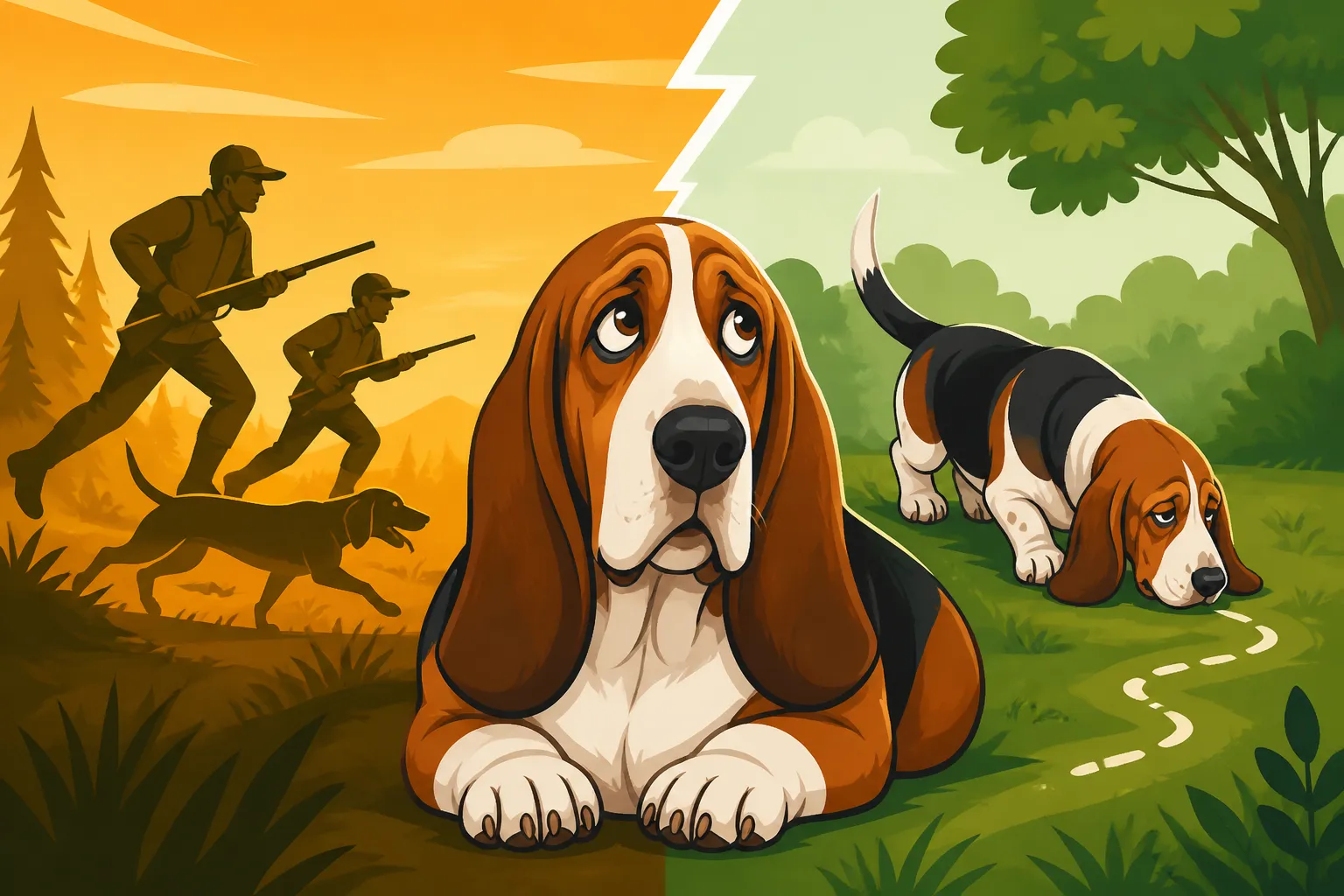
Basset Hounds were not developed so hunters could race ahead and leave them behind. Their low build and measured pace suited hunters who were walking, rather than relying on a fast horse to cover ground. A hound moving steadily along a scent trail could be followed on foot, with the hunter close enough to keep track of the dog and the hunt.
That is different from saying the dog had to be slow for its own sake. A working hound needed to find and follow scent, keep going over difficult ground, and make its position known. Speed was not the only measure of usefulness. Staying on a trail and allowing people to follow the hunt mattered more than sprinting.
The distinction helps make sense of the breed’s shape. A Basset’s short legs do limit how quickly it can cover ground compared with a taller, faster hound, but its body was not designed as a joke at the hunter’s expense. The low stature was part of a type of hunting that suited people moving at walking pace. For more background, see Why French Hunters Wanted a Slow Hound and Whether a Basset Hound Was Bred to Be Followed on Foot.
What “outrun” can mean in this context
The word can suggest two different things. One meaning is that a hunter could physically walk faster than a Basset Hound and get ahead of it. Another is that the hound’s pace was deliberately suited to a hunter following behind on foot. The second idea is a better fit for understanding the breed’s historical role.
A Basset might be slow beside a galloping horse, but mounted speed is the wrong comparison for a dog used by people walking after a scent trail. The hunter’s job was not to compete with the hound in a race. The dog worked out front, nose close to the ground; the people followed, listening and watching as it tracked.
This did not mean every hunt unfolded neatly. Scent could fade, the terrain could be difficult, and a dog might range ahead or pause to investigate. But the intended partnership was between a persistent scent hound and people who could keep pace with it—not between a sluggish dog and hunters trying to escape it.
How hunting on foot shaped the Basset Hound
A scent hound built to work close to the ground
Basset Hounds belong to a group of dogs developed for scent work. Their task was to follow an animal’s trail, not to spot it from a distance and race after it at top speed. Their low profile puts the nose near the ground, where the dog can investigate the scent it is following.
Their long ears and loose skin are also part of the familiar Basset outline, though they should not be treated as a simple set of mechanical tools. The breed’s most important working strength is its nose and its willingness to stay focused on scent. A Basset that stops to examine one especially interesting patch may look as if it has forgotten the hunt. Often, it is concentrating on the very information that tells it where the trail leads.
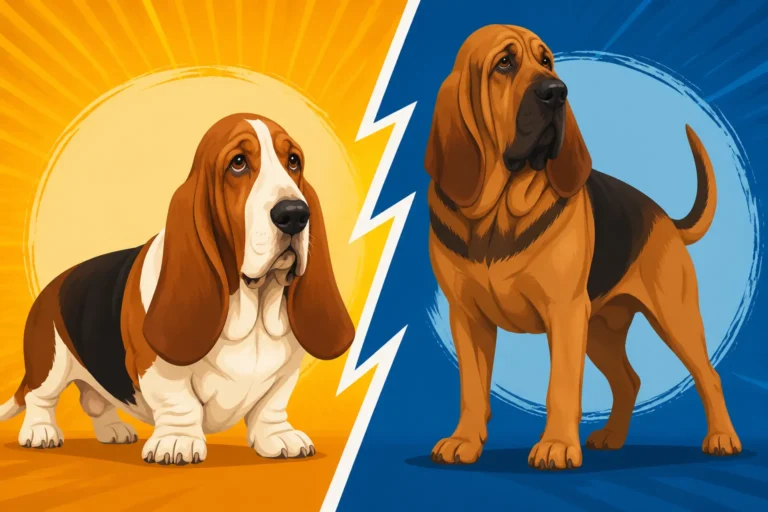
That scent-first approach explains why a Basset’s progress may look slow to someone expecting a dog to run in a straight line. A hound can double back, cast around, or spend time checking a scent-rich spot. It is following clues, not trying to win a footrace. The article The Nose That Puts a Basset Hound Second to a Bloodhound explores the breed’s scenting ability in more detail.
A pace people could follow
When hunting on foot, people need to remain near enough to follow the dog and take part in the work. A fast hound could move beyond the hunter’s reach quickly, especially over uneven ground or through cover. A steady, lower-to-the-ground hound could keep the hunt moving at a more manageable pace.
That does not mean the hunter always walked directly beside the dog. The hound still needed room to follow scent, and the people might trail behind it. The key point is that the dog’s work and the hunter’s movement could be coordinated without depending on a mounted chase.
A useful comparison is a group hike where one person is following a marked trail carefully rather than racing to the next viewpoint. The person who pauses to check the route is not necessarily failing to keep up; they are doing a different job. Likewise, a Basset moving slowly with its nose down may be working as expected, even if its human companion is ready to move on.
| Hunting feature | What it meant for the hound | What it meant for the hunter |
|---|---|---|
| Scent tracking | Followed an animal’s trail rather than relying mainly on speed | Needed to watch and listen as the dog worked |
| Short stature and steady pace | Covered ground at a pace suited to foot hunting | Could follow without depending on a fast mounted chase |
| Voice while tracking | Helped make the dog’s location audible | Could keep track of the hunt when the hound was out of sight |
| Persistence | Continued investigating a trail that might be difficult to follow | Needed patience when the dog checked or retraced a scent |
What the Basset’s hunting style looked like
Following scent instead of chasing at speed
A Basset’s work was not simply to run after an animal once it was visible. It was to follow scent through the landscape. Depending on the hunt and the animal involved, that could mean moving slowly, checking the ground, and changing direction when the trail called for it.
This is why a Basset’s quiet, nose-down walk can be more meaningful than a burst of speed. The dog is taking in information through scent and responding to it. A person walking with a Basset today may see the same tendency when the dog stops on a sidewalk verge or follows a trail through a park. The outing has become a scent investigation, not a brisk march.
Historical hunting could involve groups of hounds, with people following their progress. The details varied with local practice, the terrain, and the quarry. It is useful to avoid turning the story into a single rigid rule that every Basset always hunted in exactly the same way. For more on group work and quarry, see Whether Basset Hounds Hunted in Packs and Whether a Basset Hound Was Bred for Rabbit or Deer.
The bay helped hunters keep track
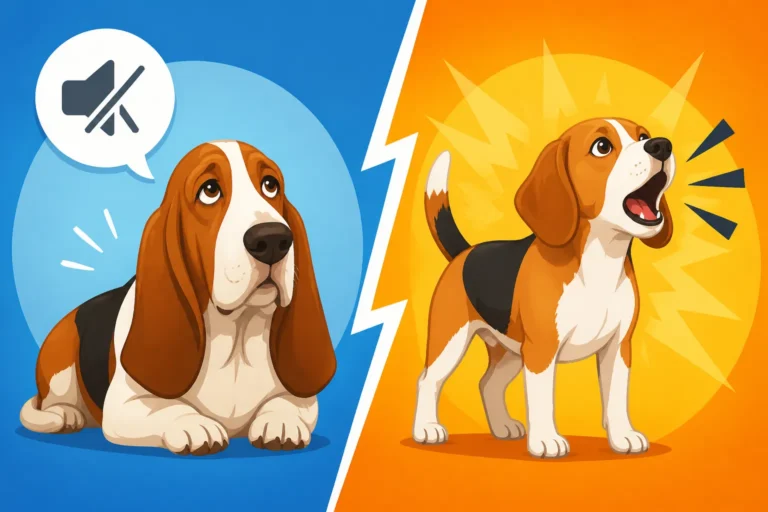
Scent hounds are known for vocalizing while they work. A Basset’s deep bay can carry across a field or through brush, helping people follow the hunt even when they cannot see the dog clearly. That voice is part of why a Basset’s presence may feel much bigger than its short legs suggest.
The bay was useful in a working context, but it can be startling in a modern home. A dog that gives voice at a scent outdoors might also howl or bay at a sound, an exciting smell, or a moment of frustration. This is not evidence that the dog was bred to be unruly. It reflects a hound’s tendency to communicate while engaged.
If you live close to neighbors, that history is worth considering before choosing the breed. Exercise and enrichment can help meet a Basset’s needs, but they do not guarantee a quiet dog. The Bay a Basset Hound Uses and the Neighbors Hear explains the breed’s characteristic voice and the practical challenges owners may face.
What this history means for Basset Hounds today
A walk may become a scent walk
A Basset’s historic working style still shows up in ordinary life. Your dog may stop at every hedge, linger over a patch of grass, or appear to ignore you when an especially interesting smell turns up. That is frustrating when you are trying to get somewhere, but it is also a normal expression of the breed’s scent-driven nature.
Rather than expecting every walk to be a fast, straight-line workout, build in time for sniffing. You can alternate between a few minutes of relaxed scent investigation and short stretches of walking together. This gives you some structure without treating every pause as defiance. For indoor enrichment, hide a few pieces of the dog’s daily food around a safe room or use a food puzzle. If you’re comparing basic enrichment supplies through retailers such as Chewy, focus on whether an item is sturdy, appropriately sized, and easy to clean rather than buying more complicated gear than your dog needs.
A secure leash is important because a Basset following a scent may become less responsive to a call. A long line can allow more exploration in an open, safe area, but it is not a substitute for a secure enclosure or attentive handling. A long line can also tangle around legs or furniture, so use it where there is room to manage it safely. See Whether a Basset Hound Should Ever Be Off Leash and Whether a Long Line Is Enough for a Basset Hound for more on managing that instinct.
Be realistic about training and recall
A Basset can learn cues, but learning a cue is not the same as choosing it over a powerful scent. Practice recall in easy, low-distraction settings first. Reward the dog generously for turning back to you, and gradually work around stronger distractions while keeping the leash secure.
For example, if your Basset is sniffing the edge of a lawn, calling once and immediately pulling the dog away may teach it that returning ends the interesting part. Instead, practice when the dog is less absorbed, reward the return, and sometimes let it go back to sniffing. That approach makes checking in with you worthwhile without pretending the hound’s nose will stop mattering.
If you shop for a harness or long line through Chewy or another retailer, check that the equipment fits your individual dog and is suitable for the place you plan to use it. A harness should not rub under the legs or restrict comfortable movement, and a long line should be handled with enough space to prevent sudden tangles. Gear can support good management, but it cannot replace training or a secure environment.
Respect the body as well as the instinct
A Basset’s willingness to follow a scent does not mean it should be pushed into every kind of exercise. The breed’s body and individual health matter. Keep walks appropriate for your dog’s age, fitness, and veterinary advice, and pay attention to signs of discomfort, fatigue, or reluctance. A dog that sits down partway through a walk may be distracted, tired, uncomfortable, or simply intent on investigating something; look at the whole situation rather than assuming it is being stubborn.
Use safe routes and suitable surfaces, especially when the weather is hot or conditions are slippery. Give your dog time to sniff without allowing it to pull you toward traffic, wildlife, or unsafe terrain. If scent games are part of your routine, they can provide mental engagement without requiring your Basset to cover long distances at speed.
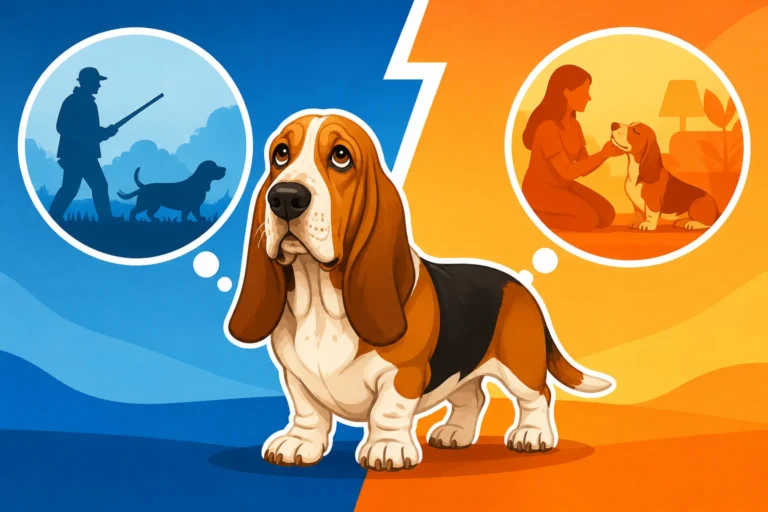
Today’s Basset Hound is usually a companion rather than a working hunting dog, but the old pattern remains recognizable: scent comes first, steady movement is normal, and a loud bay may be part of the package. For an overview of how working and show lines differ, read The Split Between Show and Hunting Basset Hounds. If you want to understand what that history looks like in a modern pet, Whether a Basset Hound Still Hunts offers a related perspective. When comparing enrichment toys or training supplies at Chewy, choose for your dog’s size, chewing style, and actual routine—not just because a product is marketed for hounds.
Disclaimer
This article is for general informational purposes only and does not constitute professional advice. Laws, prices and regulations vary by location and change over time. Consult a qualified professional for guidance on your specific situation.