How High a Fence a Basset Hound Needs
Oh, the joy and challenge of Basset Hounds! One of the biggest worries many Basset owners, or those dreaming of bringing one home, face is how to keep their determined, scent-driven companion safely contained. It’s not just about a simple fence; it's about understanding the unique traits of this wonderful breed that make traditional fencing advice often fall short. This guide will walk you through exactly what kind of fencing works best for a Basset Hound, why their distinct personality makes it a puzzle, and how to create a secure haven for your floppy-eared friend.
Why a Standard Fence Just Doesn't Cut It for a Basset Hound
Let's be real, a Basset Hound isn't your average dog. They aren't going to scale a six-foot fence like a German Shepherd, nor are they likely to meticulously unlatch a gate with their paws like some clever Border Collie. Their escape artistry comes from a completely different playbook, one written by their incredible nose and profound determination. Many owners have been baffled, heartbroken even, when their seemingly secure yard loses its Basset resident. It’s not a lack of love; it’s a pure, unadulterated drive to follow a scent.
The Irresistible Call of the Wild Scent
A Basset Hound's nose is legendary, second only to the Bloodhound in its scenting prowess. Once that incredible nose locks onto a trail – whether it's a rabbit that passed through hours ago, a squirrel, or even just a particularly interesting patch of grass where another dog marked its territory – your Basset enters a world all its own. In that moment, everything else fades away. The sound of your voice, the comfortable routine of the backyard, even the promise of a delicious treat, all become secondary to the primal urge to follow that tantalizing scent. This isn't disobedience; it's instinct. It's why Why a Basset Hound Ignores You on a Scent is such a common frustration. They're not being stubborn; they're simply responding to a biological imperative that is almost impossible to override with basic training alone, especially if they're not on a long line.
Imagine your Basset, pottering around the yard, when suddenly a faint whiff of something amazing hits their nostrils. Their head drops, tail wags, and they're off. If there's a weak spot in the fence, a gate ajar, or a low point, they will exploit it with single-minded focus. They aren't thinking about escaping the yard; they're thinking about finding that scent. The fence, to them, becomes merely an obstacle in the pursuit of their olfactory quest.
Low Rider, High Determination: The Basset's Physical Prowess
While Basset Hounds are known for their short legs and long bodies, don't let their lumbering appearance fool you into thinking they can't clear or breach a fence. They might not be Olympic high-jumpers, but they are incredibly strong, muscular, and surprisingly agile when motivated. Their low center of gravity can actually be an advantage in certain escape scenarios. They can wedge themselves under small gaps, or leverage their substantial weight against flimsy barriers.
Furthermore, their thick, heavy bones, which contribute to Why a Basset Hound Weighs as Much as a Labrador, give them significant pushing power. A Basset determined to get to a smell on the other side of a loose fence panel can exert a surprising amount of force. They are built for endurance and pushing through brush, and this applies equally to pushing through an inadequate fence. They might not jump over, but they are experts at getting through or under.
Deciphering the Ideal Fence Height for a Basset Hound
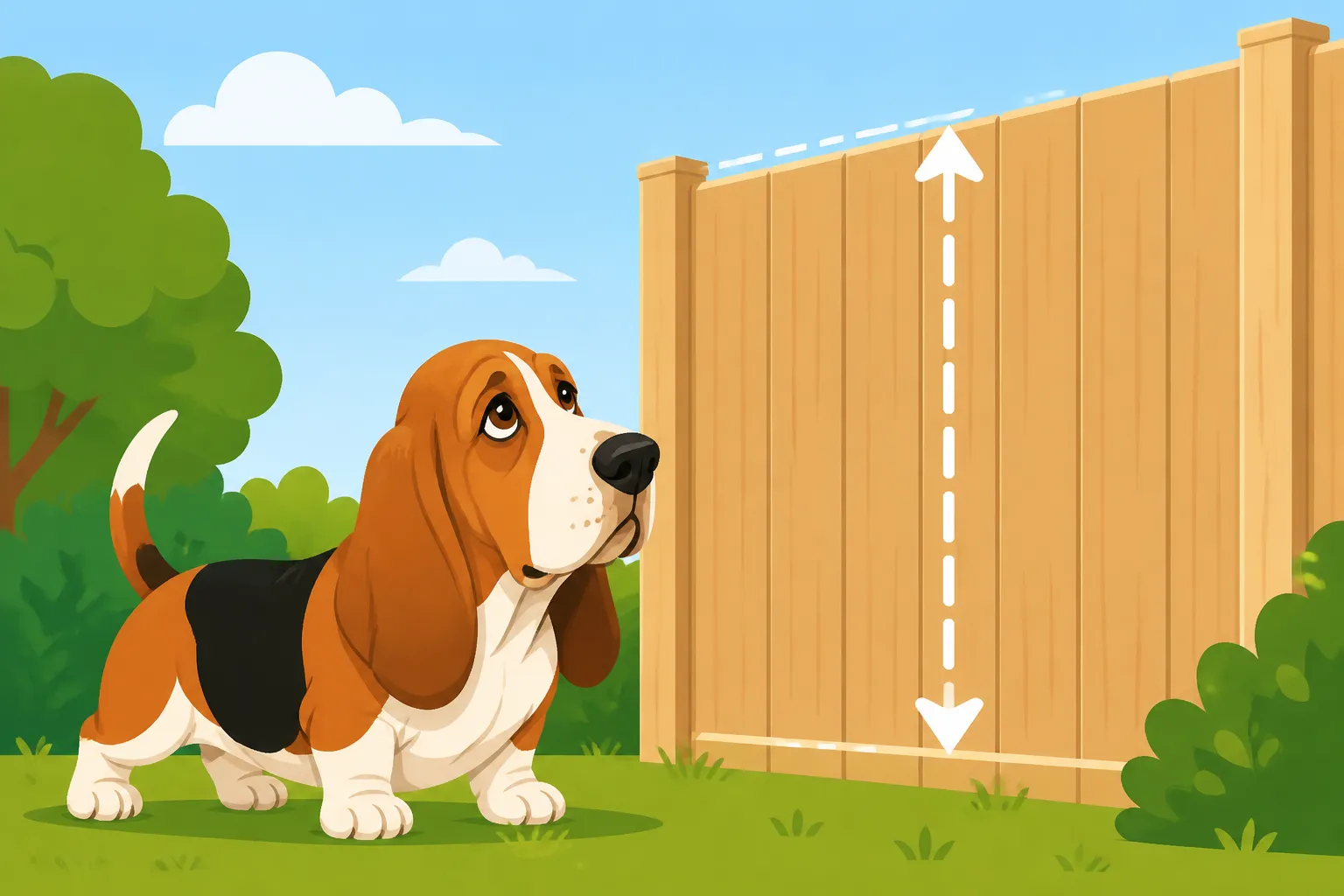
When it comes to fence height, many people mistakenly think that because a Basset Hound is short, a short fence will suffice. This is a common pitfall. While they aren't champion jumpers, their overall build, combined with their incredible drive, means you need more than just a token barrier.
The Minimum: Four Feet is a Starting Point, Not a Guarantee
For many breeds, a four-foot fence is considered adequate for containment in a residential setting. For a Basset Hound, however, this should be considered the absolute bare minimum, and even then, it comes with a significant asterisk. A Basset that isn't particularly motivated, or one that has a very strong bond and training, might respect a four-foot fence. However, if that irresistible scent wafts by, even a moderately athletic Basset can surprise you.
Consider a scenario where a squirrel dashes up a tree just on the other side of a four-foot fence. Your Basset, driven by prey drive and scent, might put in an unexpected burst of effort. They can often get enough leverage with their powerful hind legs to hoist themselves up, especially if there's any kind of foothold or uneven ground near the fence line. A motivated Basset can jump, or at least clamber, higher than you'd expect for their stature. For peace of mind, aiming higher than this minimum is almost always a better choice.
The Safer Bet: A Five or Six-Foot Fence
For truly secure containment, a five-foot or even six-foot fence is often recommended for Basset Hounds. This might seem overkill for a short-legged dog, but it addresses their potential to clamber and reduces the chance of them seeing an easy exit over the top, even if they manage to get some height. A solid six-foot fence leaves less opportunity for them to gauge whether they can clear it.
More importantly, a taller fence often implies a more robust construction. It means less chance of loose panels, larger, more secure gates, and a more significant barrier overall. This height makes it much harder for them to even attempt to clamber over, letting you relax a little more when your Basset is enjoying the backyard. This extra height provides a psychological barrier as well as a physical one, making the fence seem insurmountable to even the most determined scent-seeker.
Beyond Height: Comprehensive Basset Hound Containment Strategies
A fence's height is only one piece of the puzzle. Basset Hounds are notorious for finding other ways around a barrier if it's not truly secure. You need to think about what's under the fence, what's through the fence, and how secure your gates are. Ignoring these elements is like having a sturdy front door but leaving a window wide open.
Stopping the Diggers and Squeezers
Many Basset Hounds are accomplished diggers. Their strong, sturdy paws and innate desire to follow a scent or create a comfortable den can lead them to dig under fences with surprising speed and efficiency. They'll methodically scrape away soil, especially if they catch a scent wafting from underneath. A standard fence post set a foot or two into the ground often isn't enough.
To prevent digging, you need to extend your barrier underground. This can involve:
- Burying chicken wire or hardware cloth: Lay a two-foot wide section of mesh flat on the ground along the inside perimeter of your fence, then bury it under several inches of soil. When your Basset tries to dig, they hit the wire and are deterred.
- Pouring a concrete footer: This is the most robust solution, but also the most expensive and labor-intensive. A shallow concrete trench along the fence line completely prevents digging.
- Adding a "L-footer" or "skirt": Some fence installations include an L-shaped extension at the bottom that angles inward, preventing a dog from getting leverage to dig directly down.
Additionally, Bassets are surprisingly adept at squeezing through small gaps. Their loose skin and flexible bodies, combined with their low stature, mean they can often slink through openings that seem impossibly small. Always check for gaps between fence panels, under gates, and where the fence meets the house or other structures. Reinforce these areas with extra wire or sturdy boards.
Gate Security and Materials Matter
A flimsy gate or one with a simple latch is an open invitation for a Basset Hound. Their weight, if they lean against it, can sometimes pop open a cheap spring latch. Their cleverness, if they watch you, might even lead them to nose open simpler mechanisms.
- Double-latching gates: Always use at least two secure latches on any gate. A spring-loaded latch at the top and a cane bolt or barrel bolt at the bottom is a great combination.
- Padlocks: For extra security, especially if your Basset is a known escape artist, consider adding a padlock to your gate when you're not actively using it.
- Sturdy construction: Ensure your gates are made of the same robust material as your fence and are firmly anchored with strong hinges. A wobbly gate is a weak link.
- No gaps under gates: Just like the fence line, ensure there isn't a significant gap under your gate that a Basset could squeeze or dig under. Consider adding a sweep or a small concrete strip if necessary.
Regarding fence materials, different types offer varying levels of security against a determined Basset.
| Fence Type | Pros | Cons | Basset Hound Suitability |
|---|---|---|---|
| Solid Wood | Aesthetically pleasing, blocks visual stimuli | Can rot, requires maintenance, can have gaps if not tight | Good, if height and ground security are addressed. |
| Vinyl/PVC | Low maintenance, durable, solid barrier | Can be more expensive, less customizability | Excellent, if securely installed with no gaps. |
| Chain Link | Cost-effective, allows visibility | Easy to climb/scale, less visually appealing, easy to dig | Fair to Poor for escape artists; requires significant buried reinforcement. |
| Wrought Iron | Very durable, elegant, allows visibility | Expensive, can have gaps between bars, can be climbed | Good, if bars are close enough together and buried. |
| Privacy Mesh | Flexible, covers existing fences, cheap | Not a primary barrier, can tear | Poor as a primary barrier, useful as a visual deterrent on existing fences. |
For Bassets, solid fences like wood or vinyl often perform better because they remove visual distractions. If your Basset can't see the squirrel on the other side, they might be less intensely driven to get there.
The Role of Training and Technology
Even the most secure fence can't account for every eventuality. Gates can be left open by accident, or a determined Basset might just discover a new weakness. This is where good training and modern technology come in.
Firstly, consistent training is paramount. While you might not achieve perfect recall off a hot scent, working with your Basset on basic commands and boundaries can create a stronger bond and a better-behaved companion. Programs like those offered by BAXTER & Bella can provide foundational training that strengthens your relationship and helps your Basset understand expectations, even if their nose occasionally takes over. Teaching a reliable "come" in a low-distraction environment, and then gradually increasing distractions, is crucial. For more insights on their unique learning style, check out What Actually Motivates a Basset Hound.
Secondly, consider supplementary tools:
- Long lines: When your Basset is in the yard, especially initially, keeping them on a long line even within a fenced area can provide an extra layer of security and allow you to intervene if they discover a weak spot. It also allows them to explore safely.
- GPS Trackers: These devices are a game-changer for Basset owners. If, despite your best efforts, your Basset does manage to make a break for it, a GPS tracker (many of which are readily available on Amazon) can help you locate them quickly. Given that Whether a Basset Hound Follows Its Nose Into Traffic is a genuine concern, this technology can be a lifesaver. Ensure the collar is secure and comfortable, so it won't come off during their adventure.
- "Invisible" Fences (with extreme caution): While an invisible fence system might sound appealing, they are generally not recommended as a primary containment for Basset Hounds. The shock correction is often not enough to overcome the intense drive of a Basset on a scent. They will "take the hit" to follow their nose. At best, they can serve as a secondary deterrent within an already secure physical fence, but never rely on them as your sole barrier. For dogs with such a powerful drive, a physical fence remains the gold standard.
Ultimately, securing a Basset Hound requires a multi-pronged approach: a physically robust fence of adequate height with subterranean protection, securely latched gates, and a commitment to training, potentially supplemented with tracking technology. Your Basset's safety and your peace of mind are well worth the investment.
Disclaimer
This article is for general informational purposes only and does not constitute professional advice. Laws, prices and regulations vary by location and change over time. Consult a qualified professional for guidance on your specific situation.