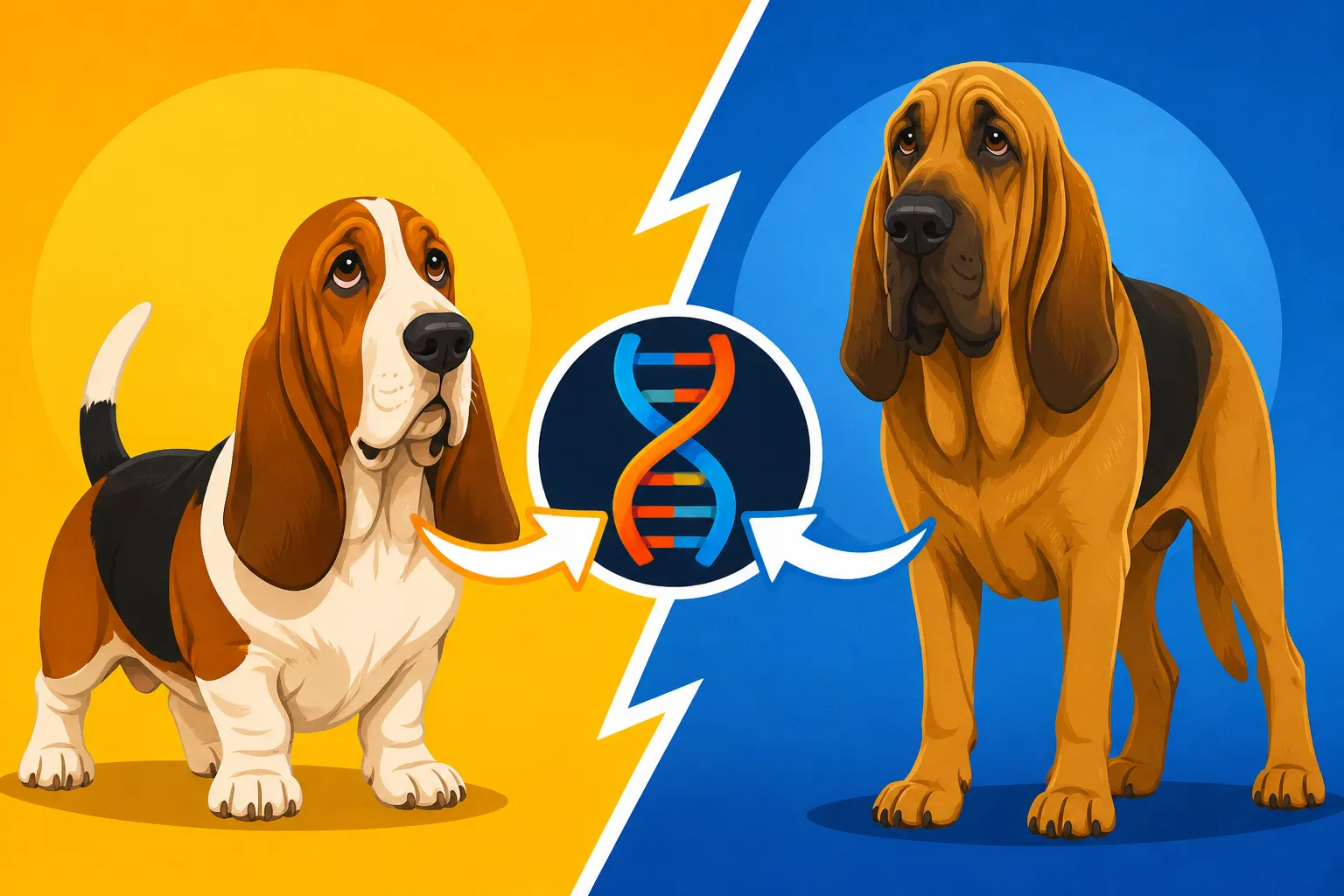
Whether a Basset Hound Is a Bloodhound Mutation
It's a common question, and one I hear quite a bit among Basset Hound enthusiasts: "Is a Basset Hound just a mutated Bloodhound?" It's easy to see why someone might connect these two breeds; they both sport those incredibly long, velvety ears, an abundance of loose skin, and that deep, soulful gaze. But the truth, as with most things canine history, is a little more nuanced than a simple mutation. This guide will walk you through the fascinating origins of both breeds, clarify their relationship, and explain why the Basset Hound, while sharing ancient roots with the Bloodhound, is very much its own distinct and wonderfully unique creation.
The Ancient Origins of Scent Hounds
To understand the Basset Hound's lineage, we first need to cast our minds back to the ancient history of scent hounds in Europe. This journey takes us far before the concept of distinct modern breeds, to a time when dogs were primarily bred for their utility in hunting.
Tracing the Ancestry of the Saint Hubert Hound
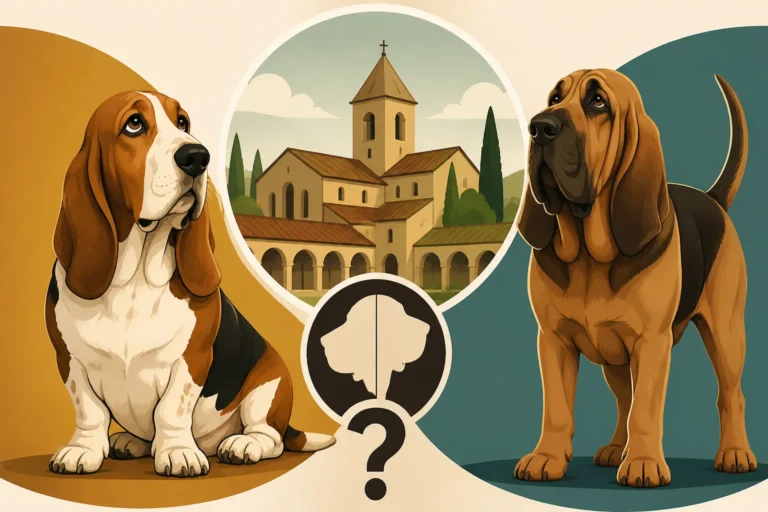
Long, long ago, in the mist-shrouded forests of what is now Belgium, an incredibly influential line of dogs began to take shape. These were the hounds associated with the Abbey of Saint Hubert, believed to have been meticulously bred by monks for their exceptional scenting abilities. Imagine powerful, deep-chested dogs, often black or black and tan, with an unwavering focus on following a trail, regardless of how faint. These dogs were primarily used to track large game, like deer and wild boar, often for hunters on horseback.
The Saint Hubert hounds were legendary for their perseverance and their incredible noses. They were the premier tracking dogs of their time, and their lineage spread across Europe as gifts and through breeding programs. These dogs were not only valued for their hunting prowess but also for their noble appearance and impressive build. They laid the foundational blueprint for many modern scent hounds, including both the Bloodhound and the Basset Hound. You can learn more about their rich history by looking into Who Saint Hubert Was and The Abbey Hounds a Basset Hound Descends From.
The Emergence of the Bloodhound as a Distinct Breed
From this shared ancient lineage, the Bloodhound, as we recognize it today, gradually emerged as a highly specialized and celebrated tracker. Over centuries, selective breeding focused intensely on enhancing its already extraordinary scenting capabilities. The Bloodhound became, and remains, the gold standard for trailing. Its physical characteristics are a testament to this singular purpose: that majestic, massive head, the deep-set eyes, the profusion of loose skin (especially the dewlap around the throat), and those incredibly long, low-set ears.
These features aren't just for show; they all play a critical role in its work. The pendulous ears sweep scent particles towards its powerful nose, while the loose skin around its face and neck helps trap and concentrate scent. Its large size and heavy bone provide the stamina needed for long, arduous trails. Historically, Bloodhounds were employed not only for hunting but also, famously, for tracking lost people and fugitives, earning them the moniker "sleuth hounds." They possess a deep, resonant bay that signals their progress on a trail, a sound that is both powerful and unmistakable. Their genetic closeness to the ancient Saint Hubert type is a key part of why some might mistakenly assume a direct, more recent "mutation" link to Basset Hounds. You might be interested in Whether the Bloodhound Came From the Same Abbey to further explore this connection.
The Basset Hound's Unique Development in France
While sharing a distant ancestor with the majestic Bloodhound, the Basset Hound's journey took a distinct turn, driven by a very specific set of hunting needs in France. This wasn't about mutation, but about adaptation through selective breeding.
The French Desire for a Low-to-the-Ground Hunter
Imagine hunting in the dense, often thorny underbrush of medieval France. If you were a hunter on foot, trying to follow a large, fast hound like the Saint Hubert on horseback, you'd quickly find yourself at a disadvantage. There was a clear need for a hound that could work at a slower pace, close to the ground, allowing human hunters to keep up. This practical necessity was the crucible in which the Basset Hound, and other "basset" types, were forged.
French breeders began to selectively breed for dogs with significantly shorter legs, but retaining the superb scenting ability, stamina, and deep chest of their larger ancestors. The idea was to create a hound that could meticulously follow a cold trail through thickets, flushing game like rabbits and pheasant, without outrunning the hunter. This was a deliberate, patient process of refining desired traits over generations, not a sudden genetic anomaly. It was a clear case of form following function, where a specific hunting style dictated the physical evolution of the dog. This is precisely Why French Hunters Wanted a Slow Hound.
Distinguishing "Basset" as a Type, Not a Single Breed
It's crucial to understand that the term "basset" didn't initially refer to a single, distinct breed like the Basset Hound we know today. Instead, it was a descriptor, derived from the French word "bas," meaning "low." So, a "basset" hound was simply a low-set hound. In fact, many different French hound breeds, each with their own unique characteristics and original purposes, had "basset" versions – shorter-legged counterparts. For example, you had Basset Griffon Vendéens and others.
Our modern Basset Hound, with its distinctive heavy bone, pronounced wrinkles, and characteristic gait, coalesced from these various "basset" types into its own recognized breed. Through further selection, breeders focused on enhancing its unique attributes, such as those famously long ears and the substantial dewlap, which further aided in collecting scent close to the ground. This process differentiated it from other short-legged hounds and solidified its status as a breed with a specific look and temperament. It truly highlights how Whether Basset Was a Size Rather Than a Breed is a key historical distinction.
Examining the Genetic Connection and Differences
While the Basset Hound and Bloodhound might appear similar to the casual observer due to their shared "houndy" features, their relationship is more akin to cousins who share grandparents rather than one being a direct offspring or "mutation" of the other.
Shared Ancestry vs. Direct Mutation
Let's talk genetics for a moment. Both Basset Hounds and Bloodhounds undeniably share a deep common ancestry, tracing back to those ancient European scent hounds, particularly the revered Saint Hubert type. Think of it like a family tree where the Saint Hubert hound is a major branch, and both the Bloodhound and the Basset Hound are distinct, separate limbs that grew from that same branch. The Basset Hound isn't a "mutation" that sprang directly from a Bloodhound.
The characteristic short legs of the Basset Hound are a result of a genetic condition known as chondrodysplasia, a form of dwarfism. This trait was not a random mutation of a Bloodhound but was present in the broader gene pool of hound types and was actively selected and amplified by breeders to create the low-slung, slow-trailing dog that could be followed on foot. It was a desirable trait for a specific hunting purpose, carefully cultivated over generations, rather than a spontaneous, detrimental mutation of an existing breed. For a deeper dive, you might find Whether a Basset Hound Is Achondroplastic insightful.
Key Physical and Temperamental Divergences
Despite their shared distant heritage and common function as scent hounds, the Bloodhound and Basset Hound evolved with significant differences in both physique and temperament, reflecting their divergent breeding goals.
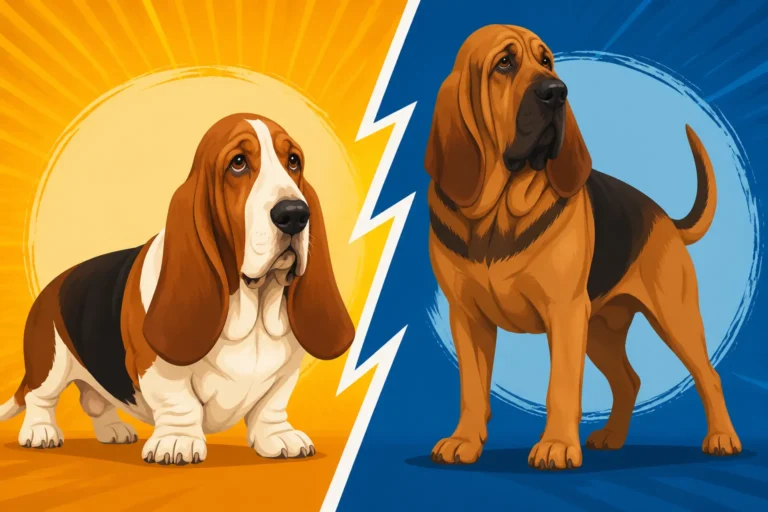
Let's put some of these differences side-by-side:
| Feature | Bloodhound | Basset Hound |
|---|---|---|
| Size/Weight | Large (80-110 lbs), powerful, substantial | Medium (40-65 lbs), heavy-boned for its size |
| Height | Taller, typically 23-27 inches at the shoulder | Much shorter, typically 14-15 inches at the shoulder |
| Legs | Long, straight, muscular for covering ground | Very short, bowed front legs, adapted for low-to-ground work |
| Ears | Extremely long, thin, velvety; set low | Very long, heavy, folded; set low, often dragging |
| Loose Skin | Abundant, especially on head and neck (dewlap) | Plentiful, particularly on face, neck, and chest |
| Expression | Solemn, deeply wrinkled, almost melancholic | Gentle, soulful, often droopy-eyed |
| Scenting | Unrivaled "super-tracker," often used for trailing people | Excellent ground-trailer, tenacious, methodical |
| Temperament | Dedicated, persistent, often aloof; needs a "job" | Gentle, placid, notoriously stubborn but affectionate |
| Vocalization | Deep, powerful bay, often used extensively on trail | Characteristic bay, also capable of mournful howls |
As you can see, while both breeds are masters of scent, their physical forms were optimized for different styles of hunting and companionship. The Bloodhound, with its immense size and relentless focus, is built for endurance and covering vast distances, often with a certain gravitas. The Basset Hound, conversely, is engineered to be slow, deliberate, and to hug the ground, making it easier for a walking hunter to follow. Its famously short, bowed legs are a perfect example of this adaptation, a feature you can explore further in Why a Basset Hound's Legs Are So Short.
The Role of Selective Breeding in Shaping Modern Basset Hounds
The Basset Hound we cherish today is not a happy accident or a mutation. It's the product of centuries of thoughtful, even meticulous, selective breeding, where specific traits were intentionally exaggerated to fulfill a particular purpose.
Emphasizing Desired Traits in the Basset Hound
Early French breeders had a clear vision: a hound with an exceptional nose that could work slowly and deliberately, allowing hunters on foot to keep pace. To achieve this, certain physical characteristics were actively encouraged and intensified over generations.
The incredibly long, heavy ears, for instance, are not merely charming; they serve a functional purpose. When the Basset Hound's nose is to the ground, these long ears sweep forward, stirring up ground scent and funneling it directly towards the nasal passages. This amplifies their already phenomenal sense of smell. Similarly, the copious loose skin, particularly the prominent dewlap and facial wrinkles, acts like a scent trap, holding airborne scent particles close to the dog's nose, ensuring no crucial detail is missed. This functional elegance of their design is truly remarkable. If you're curious about this, reading Why a Basset Hound's Ears Help It Smell offers a fascinating insight.
And, of course, the signature short, heavy, and often bowed legs were paramount. These unique legs enable the Basset to stay low to the ground, methodically working a trail without tiring its human companion, or running off ahead, which can be a common frustration for owners of quicker hounds. Each of these exaggerated features was a conscious choice by breeders, finely tuning the Basset Hound into the ultimate slow-and-steady scenting machine.
The Journey to Kennel Club Recognition and Modern Standards
As dog breeding evolved and formalized in the 19th century, particularly in Britain and then America, the Basset Hound began its journey from a regional French hunting dog to an internationally recognized breed. When Basset Hounds were first imported to Britain and later to the United States, breeders continued to refine the type, often aiming for a more uniform and distinctive appearance.
Kennel clubs, like the American Kennel Club (AKC), established breed standards that codified the desired physical traits: the maximum height, the specific ear length, the amount of loose skin, and the characteristic bone structure. These standards, while aiming to preserve the breed's unique qualities, sometimes led to a further exaggeration of features. The goal was to maintain the breed's identity as a distinct "low" hound, separate from its taller hound cousins. This standardization solidified the Basset Hound's unique place in the canine world, distinct from any notion of it being a mere variation of the Bloodhound. You can trace this formal recognition by looking into When the Basset Hound Reached Britain and The Year the AKC Recognized the Basset Hound. It's interesting to consider how these historical documents shape what we expect from a Basset Hound today, and places like Chewy often cater to these breed-specific needs with specialized products.
Why the Misconception Persists
It's completely understandable why someone might initially wonder if a Basset Hound is a Bloodhound mutation. There are some very striking similarities that, without diving into the historical lineage, can lead to such a conclusion.
Superficial Similarities in Appearance
Let's be honest, both breeds have a very "houndy" look that immediately connects them in the public's mind. Those long, soulful, droopy eyes that can melt your heart. The abundant, loose skin that forms noble folds and wrinkles around their faces and necks. And, of course, the pièce de résistance: those magnificent, pendulous ears that seem to defy gravity and logic.
These are what we might call "convergent traits." They evolved or were selectively bred for similar purposes – enhancing scent detection – from a shared ancestral pool, but they didn't arise from one breed directly mutating into the other. It's like how both bats and birds have wings for flight; the wings serve a similar function and might look superficially similar, but they evolved independently from different ancestral limb structures. Similarly, the Basset and Bloodhound developed these features to optimize their scenting prowess, making them look alike in certain key aspects. This visual overlap is the primary reason the "mutation" theory often surfaces. When you see a young Basset Hound puppy on Chewy’s website, the family resemblance to other hounds is clear, even if their specific evolution differs.
Shared "Hound" Characteristics and Scenting Prowess
Beyond just physical appearance, both breeds share fundamental characteristics inherent to their classification as scent hounds. They both possess an absolutely incredible sense of smell, arguably among the best in the canine kingdom. This shared superpower means they approach the world nose-first, driven by an insatiable desire to follow a fascinating scent trail.
They also share a distinctive vocalization: the bay. While a Bloodhound's bay is generally deeper and more resonant, a Basset Hound's bay is equally unmistakable and part of its charm (or, for neighbors, its challenge!). Both breeds exhibit an unwavering persistence on a trail, often tuning out everything else once a scent has been engaged. This single-minded focus is a hallmark of the scent hound group. These deep-seated behavioral and functional similarities reinforce the idea that they are closely related. However, it’s vital to remember that these are shared family traits, not evidence of one being a direct offshoot or mutation of the other. They are both exceptional, albeit distinct, scent hounds, each developed for specific applications within the world of tracking.
Understanding the True Relationship Between Bassets and Bloodhounds
So, after all this exploration, how should we truly understand the relationship between these two remarkable breeds? It's about recognizing shared heritage while celebrating individual evolution.
A Family Tree with Different Branches
The easiest way to conceptualize the relationship between the Basset Hound and the Bloodhound is to picture a grand, ancient family tree of European scent hounds. Far back on that tree, you'd find a robust trunk representing the ancient Saint Hubert-type hounds – the progenitors. From this sturdy trunk, over many centuries, several significant branches emerged. The Bloodhound developed as one distinct, powerfully impressive branch, cultivated for its unparalleled tracking ability over long distances and its commanding presence.
Parallel to that, but distinct, another branch developed: the Basset type. This branch then further diversified, with the modern Basset Hound evolving as its own unique limb, specifically bred for low-to-the-ground, slow, deliberate trailing by hunters on foot. Therefore, they are not directly descended one from the other, nor is one a "mutation" of the other. They are more like close cousins, sharing the same great-grandparents (the ancient scent hounds) but having grown up in different regions with different "family traditions" (breeding goals). This distinction is fundamental to appreciating their individual histories.
Celebrating Each Breed's Individuality
Ultimately, rather than seeing the Basset Hound as a mere variant of the Bloodhound, it's far more enriching to celebrate each breed for its magnificent individuality. The Bloodhound stands as a monument to relentless tracking prowess, a serious worker with an almost legendary nose, and a noble, imposing presence. The Basset Hound, on the other hand, embodies a unique blend of determined scenting ability, charmingly placid temperament, and a comical yet endearing physical form that makes it an exceptional companion.
Each breed brings its own set of characteristics, challenges, and joys to their human families. Understanding their separate evolutionary paths helps us appreciate the deliberate choices made by generations of breeders to create these specialized, wonderful dogs. Whether you're drawn to the gravitas of a Bloodhound or the gentle, lumbering charm of a Basset Hound, you're choosing a dog with a rich history and an incredible nose. Both are extraordinary examples of what selective breeding can achieve. Many resources, including those found on platforms like Chewy, can help you find specialized care items or toys suited to the unique needs and quirks of either of these fantastic hound breeds.
Disclaimer
This article is for general informational purposes only and does not constitute professional advice. Laws, prices and regulations vary by location and change over time. Consult a qualified professional for guidance on your specific situation.