Whether a Basset Hound Is Slower Than a Beagle
A Basset Hound is usually slower and less agile than a Beagle, but that does not mean every Basset is incapable of a brisk walk or a lively chase. Their bodies, movement and working styles are different, and a dog’s age, fitness and health matter too. This guide explains what “slower” really means and how to compare the breeds fairly.
Are Basset Hounds slower than Beagles?
In general, yes: a healthy Beagle is typically quicker and more nimble than a Basset Hound. Beagles have a more compact, athletic build, while Bassets have heavier bodies and short legs. But there is no single speed that applies to every dog, and a brief burst of speed is not the same as keeping up on a walk or following a scent.
Body shape affects how each breed moves
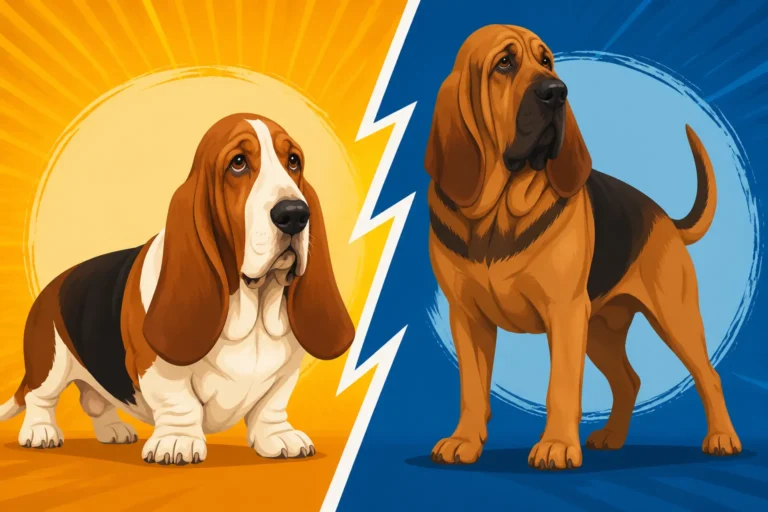
A Basset Hound’s low stature is not simply a smaller version of a Beagle’s build. Bassets are long-bodied, substantial hounds with short legs and heavy bone. Their shape gives them a low center of gravity and suits them to methodical scent work, but it does not make them natural sprinters. Their movement can look rolling or unhurried compared with a Beagle’s lighter, quicker stride.
A Beagle is also a scent hound, but its body is generally more suited to quick changes of direction and a faster, more agile pace. That does not mean a Beagle is built for nonstop running, or that a Basset should be expected to race one. Both dogs may stop frequently to investigate smells, and the apparent pace of a walk can have more to do with what the dog finds interesting than with its top speed.
The name “Basset” comes from the French word bas, meaning low. Short legs and a low-to-the-ground outline are central to the breed’s appearance, but those features should not be mistaken for a guarantee that every Basset moves slowly or awkwardly. Learn more about the breed’s proportions in Why the Word Basset Just Means Low.
Scent work changes the meaning of speed
When people compare the breeds, they often picture a straight sprint across a field. But Basset Hounds were developed to follow scent, not to win a footrace. Their steady, nose-led approach is part of their working style. A dog following an interesting trail may cover ground determinedly while appearing slow because it pauses, checks the scent and changes direction.
Beagles also follow scents with great enthusiasm. A Beagle may seem faster because it can move more nimbly through turns or cover ground in a livelier-looking way. But both breeds can become absorbed in a trail and difficult to redirect. A dog’s willingness to follow a smell is not a reliable measure of its running speed—or of how well it will respond to recall. For the Basset’s traditional working pace, see Whether a Basset Hound Was Bred to Be Followed on Foot and The Nose That Puts a Basset Hound Second to a Bloodhound.
What makes one Basset Hound faster than another?
Breed tendencies are a useful starting point, not a diagnosis of an individual dog’s ability. A young, lean, healthy Basset may move more energetically than an older or overweight Beagle. Conversely, a Basset that seems unusually slow may be in pain or uncomfortable, rather than merely showing typical breed behavior.
Age, conditioning and weight matter
Puppies are still growing, so their activity should be appropriate for their age and development rather than built around long runs or repeated high-impact exercise. Adult dogs also vary widely. One may enjoy a steady neighborhood walk, while another prefers shorter outings punctuated by frequent sniff breaks. Gradual conditioning can improve fitness, but it cannot change a dog’s basic anatomy.
Weight is particularly important for a short-legged, long-backed breed. Extra weight can make movement harder and place additional strain on joints and the back. If a Basset has become less willing to walk, pants more than usual, or struggles to get up, don’t assume that laziness is the whole explanation. A veterinarian can help assess body condition and check for pain or other health concerns. What Extra Weight Does to a Basset Hound explains why maintaining a healthy weight matters, while Whether a Basset Hound Is Lazy or Sore can help you think through a change in activity.
Age can change pace too. An older dog may need shorter, slower walks and more rest, even if it used to move happily for longer. The useful comparison is not whether the dog can match a younger Beagle, but whether it is comfortable and functioning normally for its own age and health.
Pain can look like a slower pace
A dog that slows down suddenly, lags behind, repeatedly sits or refuses a familiar route may be communicating discomfort. Watch for changes such as stiffness after resting, reluctance to climb steps, a shortened stride, limping, trembling or a newly hunched posture. These signs are more informative than comparing one breed’s pace with another’s.
Basset Hounds can be prone to musculoskeletal and back problems, so a noticeable change in movement deserves attention. Beagles can have health issues too; being the faster breed on average does not make an individual Beagle immune to pain or fatigue. If your dog’s pace has changed abruptly, or movement seems uncomfortable, arrange veterinary advice rather than trying to exercise through it.
A dog that has always walked slowly but remains comfortable, eager to sniff and willing to move may simply have a different style. A dog that once kept up and now avoids activity is a different situation. That distinction is more useful than labeling the whole breed as slow.
How should you exercise a Basset Hound and a Beagle?
Neither breed should be judged by how fast it can run alongside a person. A sensible routine should fit the individual dog’s age, health and fitness, with time to sniff and recover. For many hounds, a walk that includes exploration is more satisfying than a forced march at a fixed pace.
Choose walks for comfort, not competition
Start at a pace your dog can maintain comfortably. If your Basset regularly falls behind, stop to check whether it needs a sniff break, a rest, water or a shorter route. Avoid trying to make a Basset keep up with a faster Beagle simply because the dogs are walking together. Separate walks can be a practical solution when their needs differ.
For a Basset, it is especially sensible to limit repeated high-impact jumping and to take care on stairs or slippery surfaces. A steady walk on suitable ground is different from demanding a long run, and dogs that are not conditioned for activity should build up gradually. Beagles may enjoy a livelier pace, but they also need sensible progression and rest. See How Far a Basset Hound Should Walk and Whether a Basset Hound Can Hike for more on planning activity around a Basset’s needs.
If you want to jog with a dog, do not use the breed comparison as the deciding factor. Consider the dog’s age, body condition, joints, breathing, training and the surface and weather. Check with your veterinarian before starting a strenuous routine, particularly for a dog with a history of lameness or back trouble. Whether a Basset Hound Should Jog With You covers why jogging is not automatically suitable just because a dog seems enthusiastic.
Keep scent-driven dogs safely under control
A Basset Hound or Beagle may become so absorbed in a scent that it stops paying attention to its handler. That can make off-leash exercise risky, especially near roads, livestock or unfamiliar trails. A securely fenced area or a well-fitted harness attached to a long line can give a dog room to explore while keeping it connected to you.
Choose equipment that fits the dog’s body and allows natural movement. A harness should not rub behind the legs or restrict the shoulders, and you should check it regularly as your dog’s weight or coat changes. If you browse Chewy for a long line or harness, use the measurements and fit guidance for the specific item rather than choosing by breed label alone. A long line is a management tool, not a substitute for supervision; Whether a Long Line Is Enough for a Basset Hound offers more context.
Scent games can also provide enjoyable activity without asking a Basset to run fast. Hide a few pieces of the dog’s daily food around a safe room or yard, or let the dog investigate a new walking route at a comfortable pace. If you look at sniffing toys or puzzle feeders on Chewy, choose one that is sturdy, appropriately sized and easy to clean. For outdoor gear, Chewy listings may help you compare styles, but fit, safe use and your dog’s comfort should guide the final choice.
Basset Hound versus Beagle at a glance
| Quality | Basset Hound | Beagle |
|---|---|---|
| Typical movement | Often steady and deliberate | Often quicker and more agile |
| Body type | Low, long and substantial | More compact and athletic |
| Scent-following | Persistent and methodical | Persistent and often lively |
| Running suitability | Not generally a breed to choose for sustained running | May be more energetic, but individual fitness still matters |
| Best comparison | Comfort and stamina for that individual dog | Comfort and stamina for that individual dog |
The table describes common tendencies, not a rule for every dog. A Beagle may be unfit, elderly or recovering from an injury; a Basset may be young, healthy and eager to move. If you are choosing between the breeds, compare the daily routine you can provide, their exercise and training needs, and the particular dog’s temperament and health—not speed alone. For a broader side-by-side look, read The Basset Hound Against the Beagle.
If you already have both breeds, let each dog set a comfortable pace. One may need a longer, brisker outing while the other enjoys a shorter route with more sniffing. The aim is not to make them move alike; it is to give each dog safe, enjoyable activity that suits its body.
Disclaimer
This article is for general informational purposes only and does not constitute professional advice. Laws, prices and regulations vary by location and change over time. Consult a qualified professional for guidance on your specific situation.