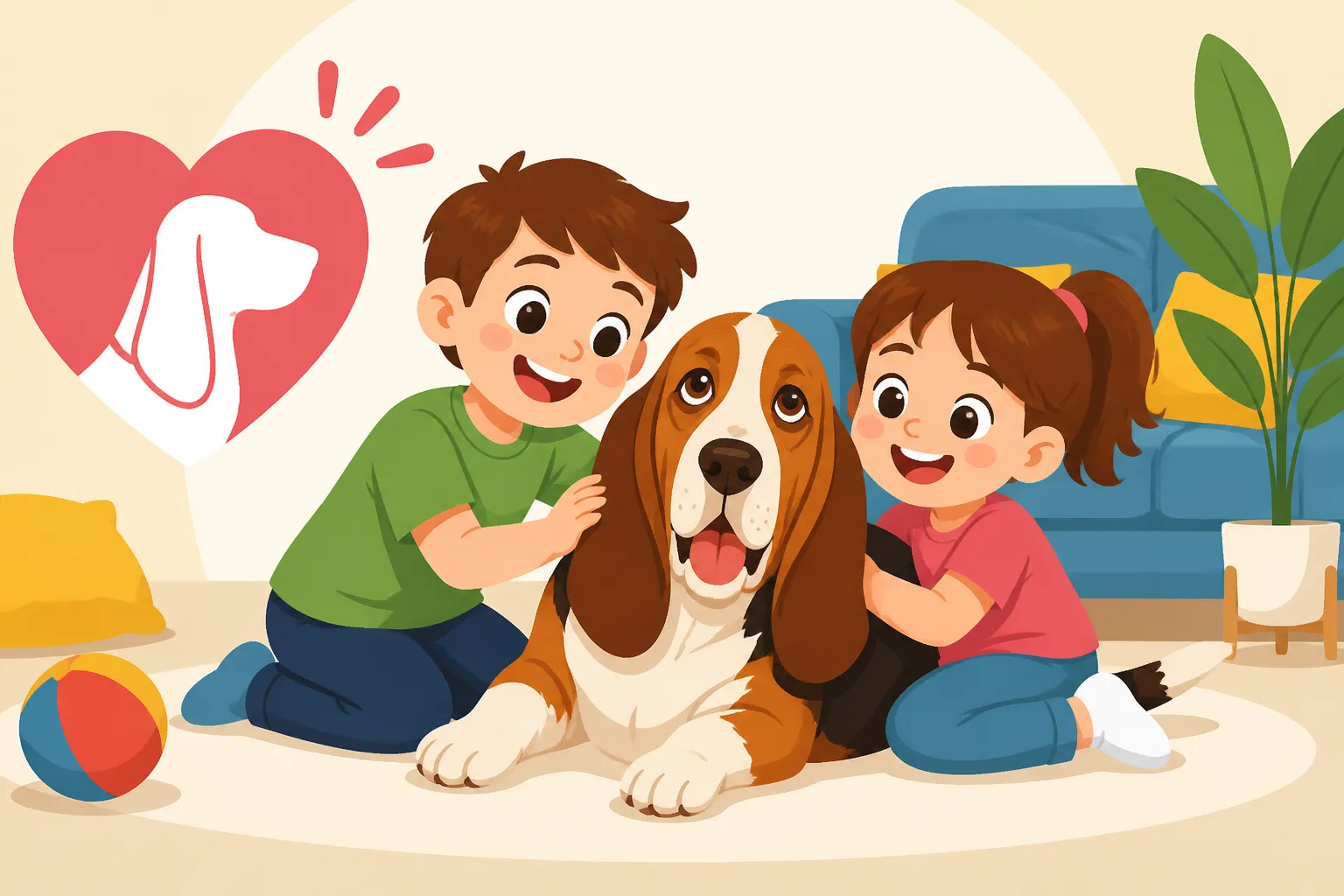
Whether a Basset Hound Suits a Family With Young Children
A Basset Hound can be a warm, easygoing companion for a family with young children, but a sweet expression is not a safety plan. Their size, stubborn streak, food motivation, and need for gentle handling all matter in a busy home. This guide explains how to judge the match, help children interact safely, and set up routines that give both dog and child room to thrive.
How Basset Hounds Tend to Behave Around Children
Their gentle reputation is only part of the picture
Many Basset Hounds are affectionate, sociable dogs that enjoy being near their people. A calm adult may tolerate ordinary household noise and settle nearby while children play. Their patient-looking, unhurried manner can make them seem like an obvious family dog.
But breed tendencies are not a promise about an individual dog. A Basset Hound can be startled, sore, frightened, or simply uninterested in being touched. Even a friendly dog may growl or snap if a child grabs an ear, climbs onto its back, corners it, or wakes it suddenly. A growl is important communication, not misbehavior to punish.
Bassets are also scent hounds. If a dropped snack, open lunchbox, or food left at toddler height catches their attention, they may focus intensely on getting it. A child who reaches toward the dog’s bowl or tries to take a stolen treat could be bitten, even if the dog is normally affectionate. For a fuller picture of their personality and family fit, see The Household a Basset Hound Actually Fits.
Their size and build can surprise small children
A Basset Hound is low to the ground, but not necessarily small or light. A child who is learning to walk can be knocked over by a dog that turns quickly, noses into a game, or simply gets excited. A Basset’s long body and short legs can also make awkward climbing or rough play especially concerning.
Children may interpret a dog lying still as an invitation to cuddle. The dog may be resting, trying to get away from noise, or guarding a comfortable spot. Teach children that lying down does not mean “available for touching.” If the dog moves away, the interaction is over; children should not follow, block, or pull it back.
Some Basset Hounds are also vocal. A sudden bay or howl can frighten a toddler, while a child’s shrieks may excite or unsettle the dog. Noise tolerance varies, so observe how your dog responds rather than assuming it will ignore the commotion. The Bay a Basset Hound Uses and the Neighbors Hear explores the breed’s characteristic voice and what to expect at home.
A puppy is not automatically the easiest choice
A puppy can grow up alongside children, but puppy behavior can be a lot to manage. Mouthing, jumping, chewing, accidents, and restless play are normal parts of development. A young child may not understand how to redirect a puppy gently, while the puppy may not yet know how to settle around small hands and quick movements.
An adult Basset Hound may have a more predictable temperament, but its history with children still matters. Ask a rescue or previous caregiver how the dog behaves around toddlers, handling, food, toys, and household noise. A dog described as “good with kids” may have lived with calm older children, which is not the same as being comfortable around a crawling baby or a preschooler who is still learning boundaries.
Whichever age you consider, look at the individual dog’s behavior in context. Does it choose to approach? Can it relax when people move around? Does it recover after a surprise? A meeting is useful, but it cannot guarantee how the dog will behave after moving into a home. A careful transition and ongoing supervision matter more than a single promising introduction.
How to Keep Interactions Safe
Supervise closely and create space
Young children and dogs should have an attentive adult supervising every interaction. “Supervising” means staying close enough to intervene immediately—not watching from another room or relying on a child to follow the rules. If you need to answer the door, cook, or help another child, separate the dog and child first.
Use gates, a pen, or a quiet room to give the dog a child-free retreat. That space should never become a place where children follow the dog to cuddle or play. A gate can also help during busy moments such as meals, visitors arriving, or an energetic playdate. Families comparing home setups may find The Household a Basset Hound Actually Fits helpful when planning how much room and separation a dog needs.
| Situation | Safer approach | Why it helps |
|---|---|---|
| The dog is sleeping or resting | Leave it alone and keep children back | Startling a dog can lead to a defensive reaction |
| The dog has food, a chew, or a toy | Keep children away; an adult handles any exchange | Reaching for valued items can trigger guarding |
| The child wants to pet the dog | Invite the dog to approach; use calm, gentle strokes | The dog can choose whether to interact |
| The household is noisy or busy | Use a gate or the dog’s quiet retreat | A break can prevent stress from building |
| The dog walks away | Let it go and do not follow | Moving away is a request for space |
An adult should also watch for signs that the dog needs a break. Turning away, moving off, hiding, becoming unusually still, licking its lips, yawning, or showing the whites of its eyes can indicate discomfort or stress. These signals are easy to miss when a child is excited. If you see them, calmly separate the pair and give the dog time to settle.
Teach children simple, repeatable rules
Toddlers cannot be expected to manage a dog’s feelings independently. Keep household rules short and consistent: no climbing, pulling, hugging tightly, chasing, disturbing sleep, or taking food and toys. Show children how to touch gently on the shoulder or chest if the dog is relaxed and has chosen to come close. Avoid asking a young child to put their face near the dog’s face.
Make interactions brief and positive. An adult can help a child toss a treat onto the floor rather than hand-feeding it, especially if the dog is excitable or highly food-focused. Do not use a child as the person responsible for taking away a bone, stopping rough play, or correcting the dog.
Children also need to learn that a dog’s bed, crate, or gated area is off-limits. It helps to explain this as the dog’s own quiet place, much like a child’s bedroom. These boundaries are not a rejection of the child; they are part of making shared life comfortable and predictable.
For a broader look at gentle introductions and realistic expectations, A Basset Hound in a House With Children offers related guidance. If your child is still very young, remember that skills develop gradually. An adult must maintain the safety rules even when a child seems to understand them.
Protect food, toys, and resting places
Separate the dog from children during meals, and do not allow children to approach the dog’s bowl while it is eating. Pick up dropped snacks promptly, keep lunchboxes out of reach, and use closed bins for food waste. Basset Hounds can be persistent when they smell something tempting, so a counter or low table may not be a reliable barrier.
Set clear expectations for toys. A child’s plush toy may look very much like a dog toy, and the dog may grab it. Store children’s toys when they are not being used, provide suitable dog toys, and teach children not to chase the dog to retrieve an item. If the dog takes something unsafe, an adult should manage the situation rather than having a child reach into its mouth.
Food guarding or guarding of a bed or toy deserves careful attention. Do not punish growling or force the dog to surrender an item; that can make a tense situation less predictable. Separate the dog and child, then consult a qualified, reward-based trainer or veterinary professional for help. Whether a Basset Hound Guards Its Food gives more detail about this behavior and why prevention matters.
What to Consider Before Bringing One Home
Match the dog to your family’s actual routine
Think about what your home is like on an ordinary weekday, not just during a quiet visit. Is there a crawling baby, a newly mobile toddler, or a preschooler who wants to hug every animal? Will adults be able to supervise, maintain gates, and keep food and toys organized? Is there a calm place where the dog can rest without being followed?
Consider the dog’s age, temperament, and background. A confident dog accustomed to children may be a better fit than one that is fearful, easily startled, or uncomfortable with handling. Still, temperament is individual: a history of living with children does not remove the need for supervision. If adopting, ask what the dog has actually experienced and how it responded, rather than relying on a broad label such as “family friendly.”
It is also worth preparing the physical environment. Non-slip rugs can help a dog move confidently, and barriers can keep children away from stairs or resting spaces. If you are gathering supplies, Chewy may be one place to compare gates, washable bedding, and dog-safe toys; choose products based on your home layout and your dog’s needs rather than assuming a particular item will solve a behavior problem.
Plan for care as well as companionship
A Basset Hound needs more than affection and a comfortable sofa. Regular exercise, training, grooming, and health care take time, and a dog’s needs do not pause when family life gets hectic. A child can help with age-appropriate tasks, such as putting a toy in a basket with an adult nearby, but adults remain responsible for the dog’s welfare.
Keep the dog’s health in mind when planning children’s activities. If the dog seems reluctant to be touched, limps, or has a change in behavior, pain or illness may be involved. A child should not be expected to recognize or diagnose those signs. An adult should provide space and arrange veterinary advice when needed. Learn more about the breed’s physical considerations in The Crooked Front a Basset Hound Is Built On and The Back Trouble a Basset Hound Is Built Into.
For routine care, write down who handles walks, feeding, appointments, and supervision. Keep cleaning supplies and grooming items out of children’s reach. Chewy can be a practical place to browse everyday items such as dog food storage containers or grooming supplies, but discuss diet, supplements, and medical products with your veterinarian rather than choosing them based on a product listing.
A child’s enthusiasm may also change over time. The adult who promises that the child will “help with everything” should be prepared to do the work if interest fades. Before choosing a dog, think through the less charming parts too: muddy ears after a walk, a dog that follows a scent instead of a command, and the steady effort of maintaining boundaries. What Basset Hound Owners Wish They Had Known can help families think about daily ownership beyond the breed’s appealing looks.
Is a Basset Hound a Good Fit for Your Family
Signs the match may work
A Basset Hound may suit your family if the adults genuinely want the responsibility, can supervise interactions, and are willing to teach children how to respect the dog’s space. It helps if your household can provide a calm retreat, keep meals and play areas organized, and maintain routines even when schedules change.
The fit is more promising when the particular dog is comfortable around children’s ordinary movement and noise, can disengage and settle, and has no known pattern of guarding or fear that the family cannot safely manage. A thoughtful introduction should be only one part of the decision, not the sole test. Ask questions, observe the dog over time when possible, and involve a qualified professional if there are concerns.
Families should also be realistic about a dog’s limits. A Basset Hound is not a stuffed animal, an unsupervised playmate, or a way to teach a child responsibility by handing over the care. Even a calm, familiar dog needs protection from rough handling and opportunities to rest.
Signs to pause or seek advice
Pause if an adult cannot reliably supervise, if children regularly ignore boundaries, or if there is no workable way to separate the dog from busy parts of the home. A dog with a bite history, serious fear of children, or resource guarding may need an experienced adult-only environment or professional assessment. That does not make the dog bad; it may mean the household is not the safest match.
Do not bring a dog into a home expecting a young child to “train it out” of growling, hiding, snapping, or guarding. Those behaviors deserve careful handling. Avoid forcing contact to help the dog “get used to” the child; repeated stressful exposure can worsen fear rather than build trust.
If you already have a Basset Hound and a child is on the way, plan changes before the baby arrives. Introduce gates, routines, and a dog-only resting area early, and seek guidance if your dog has shown anxiety or guarding. With preparation, clear boundaries, and close adult supervision, many families can build a safe and affectionate relationship—but the dog’s comfort and the child’s safety must remain equally important.
Disclaimer
This article is for general informational purposes only and does not constitute professional advice. Laws, prices and regulations vary by location and change over time. Consult a qualified professional for guidance on your specific situation.