Whether the Basset Hound Should Be Bred Back Toward Work
A Basset Hound can still use its remarkable nose, but “breeding back toward work” raises a bigger question than whether the dog can follow a scent. It asks breeders to balance hunting ability, sound movement, health, temperament, and life as a companion. Here’s what that goal could mean in practice—and how to tell whether it puts the breed’s welfare first.
What breeding a Basset Hound back toward work means
The breed’s original job was practical, not purely athletic
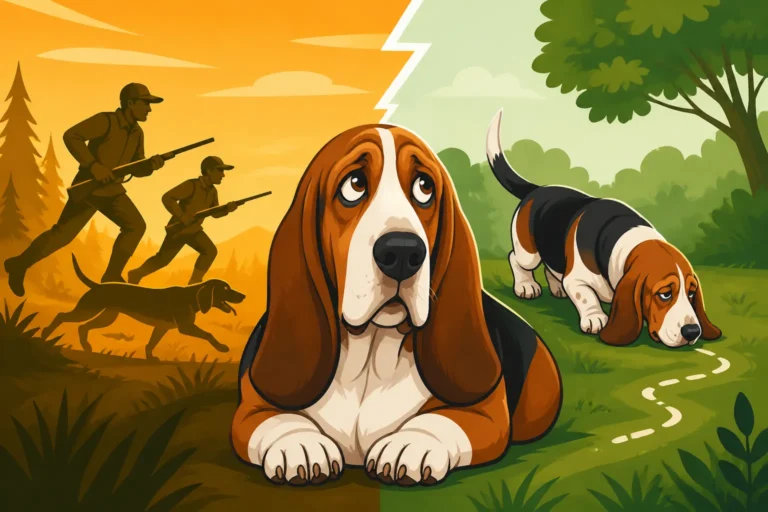
Basset Hounds were developed as scent hounds that could follow game at a pace people on foot could manage. Their work depended on persistence, scenting ability, and a distinctive voice that helped people follow the hunt—not sprinting like a sight hound or covering ground like a tall, long-legged dog. The history behind that purpose is explored in Why French Hunters Wanted a Slow Hound.
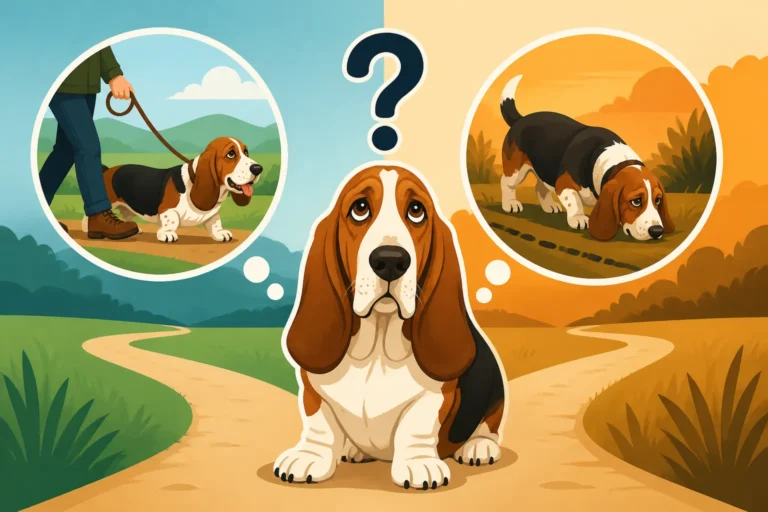
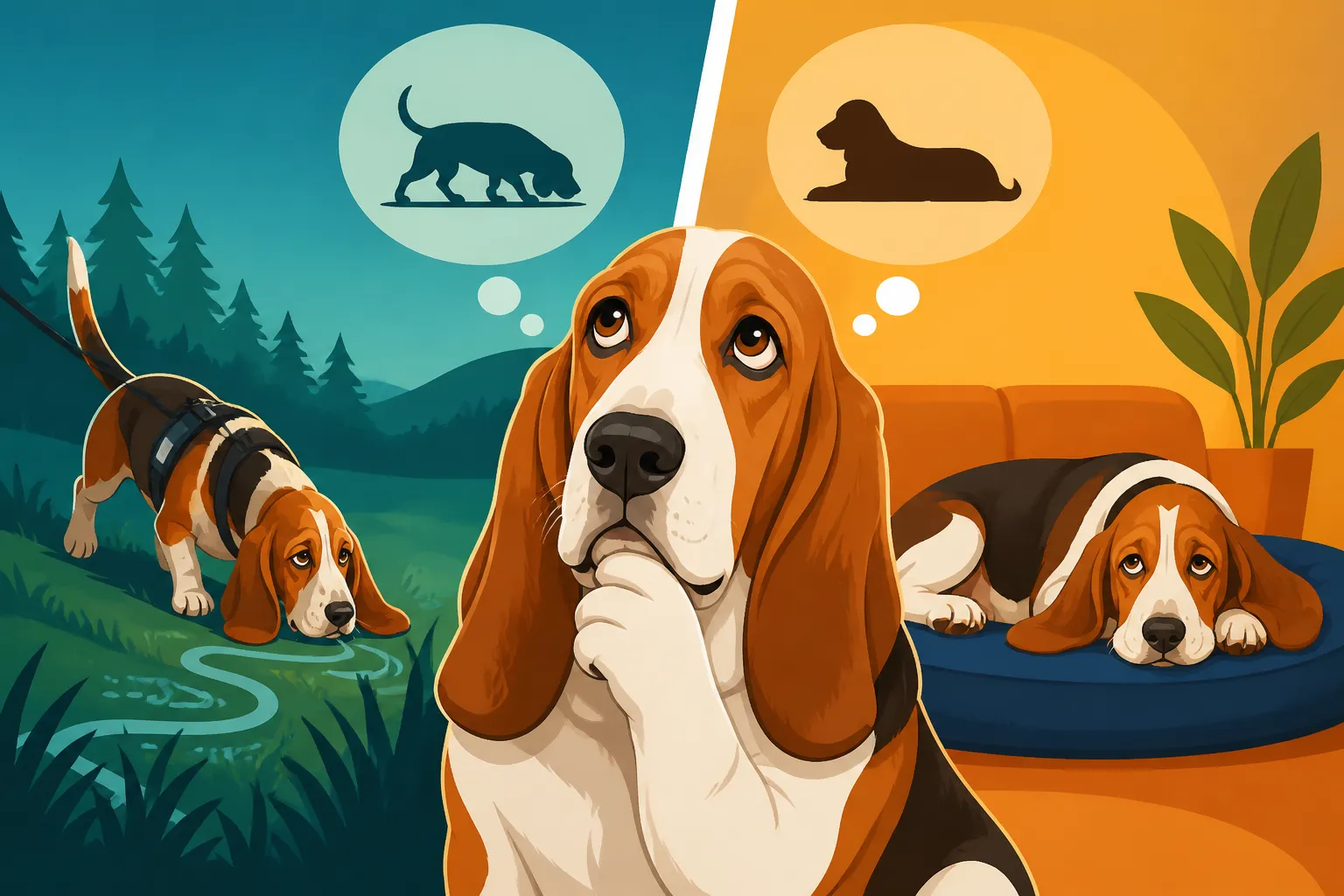
So “back toward work” should not mean turning a Basset Hound into a different kind of dog. It can mean placing more emphasis on the qualities that made the breed useful: a nose that stays engaged, stamina for measured activity, steady tracking, and a body that can move comfortably over ordinary terrain.
Those qualities do not automatically require extreme working drive. A dog can show an interest in scent and still be an easygoing household companion. Nor does a pedigree label alone prove that a Basset Hound is capable, comfortable, or suitable for hunting. Breeding goals need to be visible in the dogs themselves, not just in claims about their ancestry.
“Work” can mean more than hunting
For some people, work means traditional hunting. For others, it might mean tracking, scent-work activities, or organized trials that let a dog use its nose in a controlled setting. Those activities can offer useful ways to observe a dog’s focus and persistence without assuming every owner wants to hunt. Whether a Basset Hound Can Do Tracking Trials looks at one such option, while Whether a Basset Hound Takes to Scent Work covers another.
That distinction matters because a breed-wide breeding goal should not rely on a single activity that only a small number of owners pursue. A Basset Hound that can follow a trail in a training setting may demonstrate useful scenting behavior, but that alone does not establish that it has sound joints, healthy eyes, comfortable breathing, or a temperament suited to everyday life.
The phrase “bred back” can also suggest that there was one perfect earlier type that simply needs restoring. In reality, working and show populations can differ, and there is variation within each. Comparing the purposes and traits of different lines is more useful than treating either group as automatically superior. See The Split Between Show and Hunting Basset Hounds and Whether Show and Field Basset Hounds Differ.
A useful working dog still needs to be a sound Basset Hound
It is possible to select for scenting ability without rewarding exaggerated features or overlooking health. A practical working dog needs to be able to move comfortably, recover from normal activity, and function in the environment where it lives. The question is not whether a dog looks more “field-like,” but whether its structure and behavior support a healthy life.
That means work should be one part of the breeding picture, not a substitute for health evaluation. A dog’s ability to finish a trail does not tell you whether it carries inherited risk for eye disease, joint problems, or other conditions. Likewise, a healthy veterinary check at one point in time is not the same as a considered breeding plan that accounts for family history and appropriate health screening.
A Basset Hound’s nose is one of its defining gifts, but breeding decisions need to respect the whole animal. The Nose That Puts a Basset Hound Second to a Bloodhound discusses that scenting reputation; Whether the Basset Hound Has Been Bred Too Low raises the related question of how extreme structure may affect function.
What a work-focused breeding goal could improve
It may keep useful instincts and abilities in view
When breeders pay attention to scenting behavior, stamina, and steady movement, those traits are less likely to become an afterthought. That does not mean every puppy must be tested as a hunter. It means the breeding program can value dogs that show purposeful, comfortable use of their natural abilities, rather than selecting only for appearance or a narrow performance result.
For owners, a stronger emphasis on function could also encourage more opportunities for dogs to use their noses. A Basset Hound that gets regular sniffing walks, simple tracking games, or supervised scent activities may have a satisfying outlet for behavior that comes naturally. For a rainy-day game at home, a snuffle mat or treat-search setup can be made with household items; owners who prefer to shop for enrichment supplies may also find options through retailers such as Chewy.
That kind of activity is enrichment, not proof that a dog is a suitable breeding animal. An individual dog’s interest in scent work can be rewarding to observe, but breeding decisions should consider health, temperament, structure, and family history alongside any working ability.
It should encourage comfortable movement, not a new set of extremes
A responsible effort to preserve working ability should ask whether a dog can move freely and comfortably. It should not replace one extreme with another—for example, treating exaggerated speed, intensity, or stamina as the only marks of a worthwhile Basset Hound. A scent hound’s work can be measured and persistent; it does not need to resemble a high-speed endurance event.
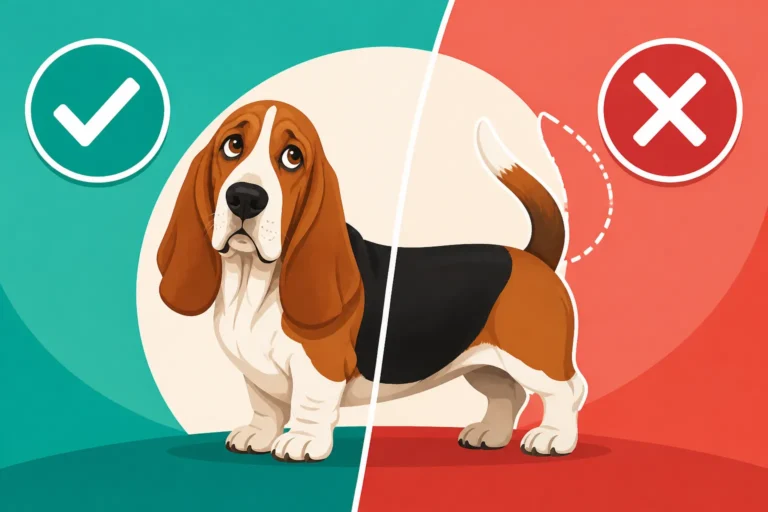
Structure is part of that conversation. The breed’s distinctive proportions deserve careful attention, especially if a dog’s movement appears painful or restricted. A breeder should be able to explain how they evaluate soundness and why they choose particular dogs, rather than relying on broad claims that a line is “more functional.” Whether a Basset Hound's Body Length Is a Welfare Problem and Whether Breeders Are Correcting the Basset Hound explore these concerns from different angles.
It also helps to remember that an individual dog’s limits vary. Age, fitness, weight, weather, terrain, and existing health conditions all affect how much activity is appropriate. A breeding program that values work should not encourage owners to push a dog past discomfort simply to prove a point.
It can support a richer life for pet Basset Hounds, too
Most Basset Hounds will not spend their lives hunting. That does not make their scenting instincts irrelevant. A dog who pauses to investigate a hedgerow, follows a food trail around the yard, or works through a scent puzzle is using part of the behavioral toolkit the breed was developed for.
The practical benefit of a work-aware breeding culture may be that breeders and owners talk more openly about what Basset Hounds need: safe opportunities to explore, patient training, and realistic expectations about recall. A scent-focused dog can become absorbed in a trail, so a secure area or leash is important. “Working ability” should not be used as a reason to let a dog roam where it could be injured or lost.
For simple indoor enrichment, an owner might hide a few pieces of the dog’s measured meal around one room and let the dog search at its own pace. Chewy is one place owners may look for food puzzles or sniffing toys, but the essential part is choosing an activity the individual dog can use safely and comfortably. New enrichment should be introduced gradually, particularly if a dog is unaccustomed to it.
How to evaluate a breeder’s claims about working ability
Ask what the breeder means by “working”
The word can cover a lot of ground. Ask whether the breeder means hunting, tracking, scent work, field events, or simply a lively interest in following smells. Then ask how they have observed that trait. A specific answer—such as describing a dog’s training, behavior, or recorded activity—is more informative than a vague promise that puppies come from “working stock.”
It is also fair to ask what kind of home the breeder believes the puppies need. Some dogs may have more persistence or a stronger interest in following scent than others. A breeder should be willing to talk about that honestly, including the everyday management involved: leash use, secure fencing, training, and appropriate enrichment.
The distinction between a dog that enjoys scent activities and one selected for demanding work should be clear. Neither is automatically better. A prospective owner looking for a calm companion deserves an accurate picture of the puppy’s likely needs, just as a person seeking a dog for a particular activity deserves realistic information about the line.
Look for health and temperament alongside performance
A title, hunting record, or impressive tracking result is only one piece of information. Ask what health issues the breeder considers in their lines, what screening they do, and how they use results when making breeding choices. Ask about the parents’ behavior in ordinary settings, too: handling, recovery from new experiences, and comfort around people and other dogs.
A useful breeding program should be able to explain its priorities and acknowledge trade-offs. If a breeder talks at length about performance but dismisses health questions, that is a reason to slow down. The same is true if a breeder treats a particular body shape as proof of soundness without being able to describe how the dogs move and function.
Here is a simple way to compare claims:
| Breeding priority | What useful evidence might look like | A reason to ask more questions |
|---|---|---|
| Scenting or tracking ability | Descriptions of observed work, training, or participation in suitable activities | “They all have great noses” with no examples |
| Comfortable movement | Observation of dogs moving freely, plus relevant health information | Appearance is treated as the only measure of soundness |
| Health | Clear discussion of screening, family history, and known concerns | Health questions are brushed aside because the dogs are active |
| Temperament | Honest descriptions of the parents’ behavior and needs | Every puppy is described as ideal for every home |
| Breed type | A clear explanation of how the dogs retain recognizable Basset Hound traits | “Working” is used to excuse poor health or extreme intensity |
These are conversation prompts, not a pass-or-fail checklist. A breeder may have a thoughtful reason for emphasizing one trait, but they should be able to explain how that choice fits into a broader plan for healthy, manageable dogs.
Be cautious about labels and guarantees
“Field-bred,” “working line,” and “show line” can help describe a breeder’s emphasis, but labels do not tell the whole story. One breeder may select for regular hunting activity; another may simply have dogs that enjoy informal scent games. Even within a single litter, puppies can differ in energy, confidence, and interest in following a trail.
A breeder cannot reliably promise that a puppy will become a particular kind of worker. Development, training, health, and the dog’s own temperament all matter. A careful breeder can describe the traits they see in the parents and relatives, explain how they match puppies to homes, and avoid guarantees that no one can reasonably make.
If your goal is a companion, ask whether the breeder’s dogs can settle at home and what daily activity they need. If your goal is hunting or scent work, ask what support the breeder provides and what experience they have with that activity. For broader context on structural priorities, Whether Breeders Are Correcting the Basset Hound is a useful related read.
Should Basset Hounds be bred back toward work
The strongest answer is yes to function, not at any cost
There is a reasonable case for keeping the breed’s original abilities in view. A Basset Hound should not be valued only as a silhouette or a collection of recognizable features. Scenting, persistence, comfortable movement, and the ability to participate in appropriate activity are meaningful parts of the breed’s identity.
But “back toward work” is not a complete breeding plan. It becomes useful only when breeders define the traits they want, assess them responsibly, and keep health and temperament central. Selecting for hunting ability while ignoring discomfort, inherited disease, or poor fit for ordinary homes would not be a genuine improvement.
In practice, the better question may be: can breeders preserve and demonstrate the Basset Hound’s natural working qualities while producing dogs that are sound, healthy, and manageable? That goal leaves room for different kinds of Basset Hound homes. It does not require every owner to hunt, every dog to compete, or every line to look exactly alike.
Owners can support working instincts without breeding a dog
You do not need a working pedigree to give a Basset Hound satisfying nose-based activities. Try short, low-pressure searches with food or a favorite toy. Let the dog investigate on walks rather than hurrying it past every interesting smell. Keep activities safe and suited to the dog’s age, fitness, and health.
If you use a puzzle feeder or snuffle mat, supervise at first and choose one that does not frustrate the dog or encourage chewing and swallowing parts. Chewy may be a convenient place to browse enrichment options, but a simple homemade search game can work just as well. The point is to give the dog a chance to sniff, solve, and succeed.
This everyday approach also makes the conversation about working ability more grounded. Instead of asking only what a breeder’s dogs can do in a formal setting, consider whether the breed’s natural behaviors can be supported in a way that is safe, enjoyable, and realistic for the dog in front of you.
A healthy future needs more than one measure of success
The Basset Hound does not have to choose between being a companion and retaining its scent-hound character. Good breeding can respect both. A dog that follows a trail with enthusiasm, moves comfortably, settles at home, and remains healthy is a more meaningful example of function than one impressive performance result on its own.
So, should the breed be bred back toward work? It should be bred with its functional heritage in mind, but not toward work as an excuse to disregard health or welfare. A balanced approach values the nose and the temperament, asks whether the body can do its job comfortably, and treats every puppy as an individual rather than a promise of performance.
Disclaimer
This article is for general informational purposes only and does not constitute professional advice. Laws, prices and regulations vary by location and change over time. Consult a qualified professional for guidance on your specific situation.